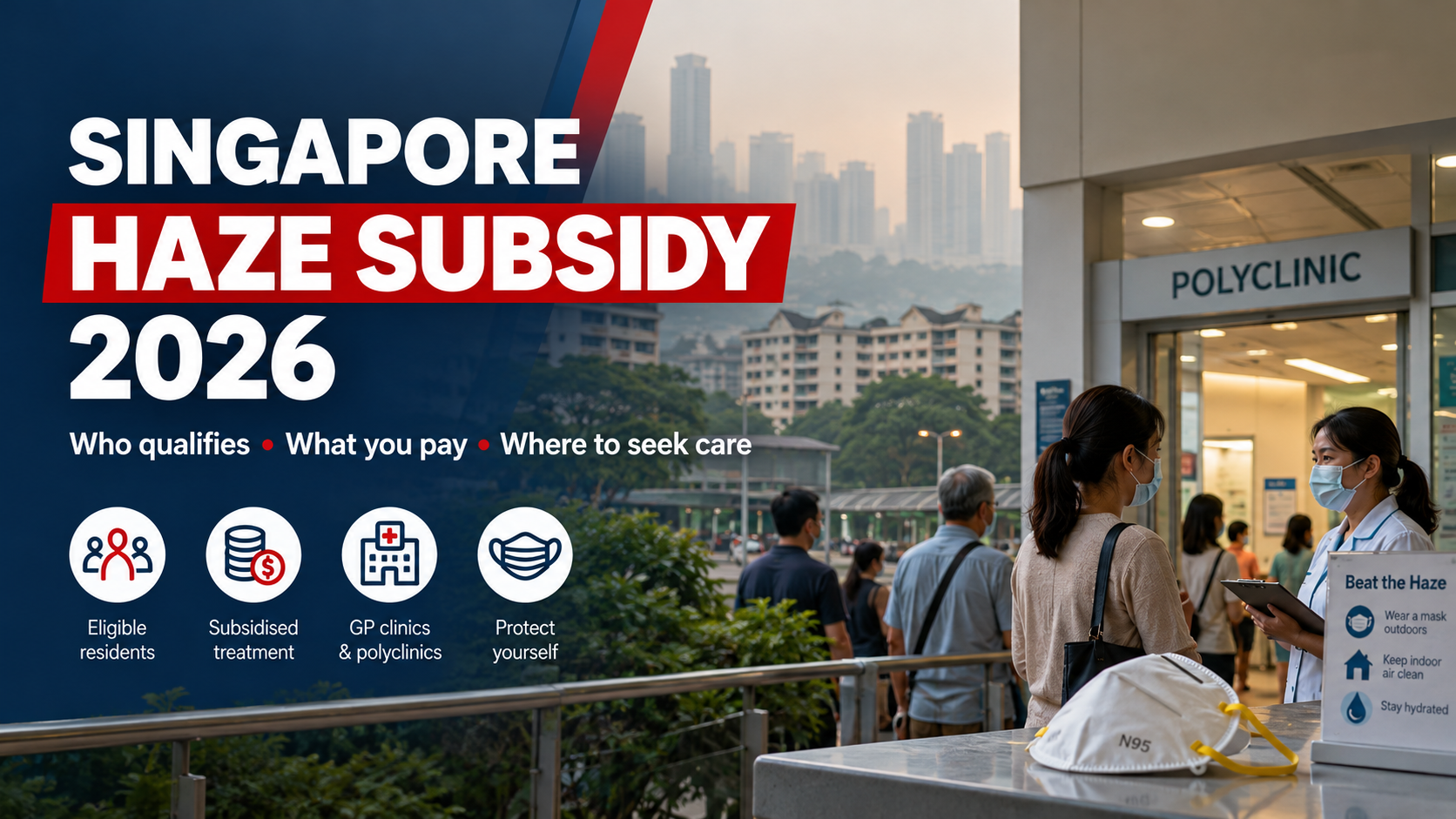
Singapore's Haze Subsidy Scheme begins on 12 October 2026 as worsening air quality raises health concerns. Find out which Singaporeans qualify for subsidised treatment, how much patients pay, which conditions are covered, and when to visit a participating GP clinic, polyclinic or emergency department.
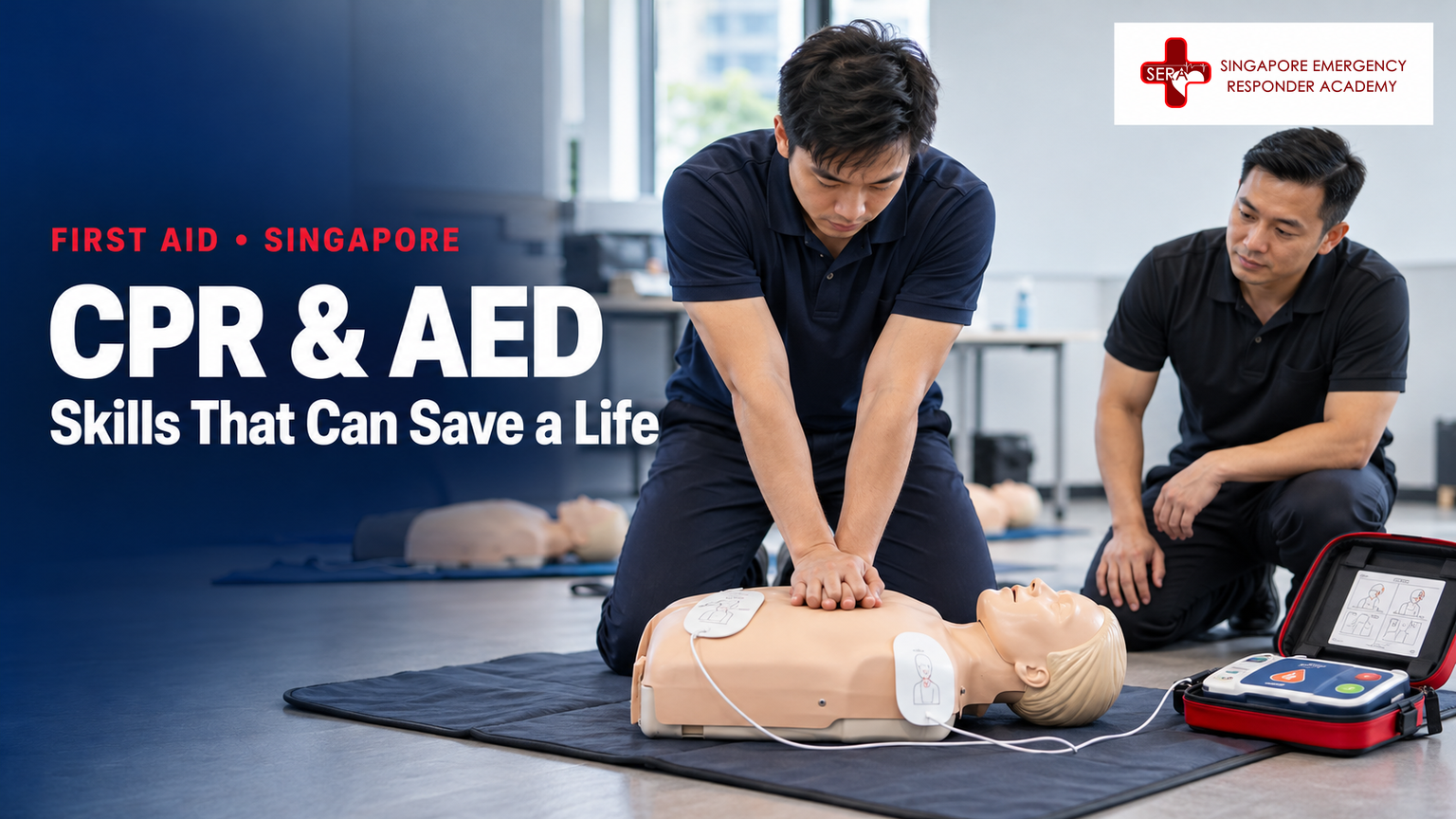
Saving A Life with CPR & AED Skills
Learner story · CPR & AED · Singapore
Originally published · Guidance reviewed
A routine jog can become an emergency without warning. For SERA learner Alvin Ho, encountering a woman who had collapsed at Punggol Waterway brought CPR and AED skills into the real world.
CPR helps circulate blood during cardiac arrest. An automated external defibrillator, or AED, checks the heart’s rhythm and delivers a shock when appropriate. Together with an early 995 call, these actions support the emergency response before paramedics arrive.
Alvin’s experience offers a practical reason to learn: you may be the person nearby when someone needs help.
Alvin Ho’s experience at Punggol Waterway
In SERA’s original September 2022 account, Alvin was introduced as the co-founder of wellness platform Fitivate and a learner who had completed a BCLS+AED refresher course.
The article described an earlier encounter while he was jogging. Alvin performed CPR and used an AED on a woman who had suddenly collapsed. According to that account, she did not regain responsiveness after two shocks; the arriving SCDF crew subsequently obtained a pulse.
The report does not establish her later recovery or hospital outcome. It does show Alvin applying his skills before professional help arrived.
“Do not hesitate anymore, you will never know when your skills will be put to good use”
— Alvin Ho, as quoted in SERA’s original 2022 article
Why CPR and AED skills work together
Cardiac arrest means the heart is no longer pumping blood effectively. CPR supports circulation, while an AED can treat certain dangerous heart rhythms. An AED does not advise a shock for every cardiac arrest.
A person may remain unresponsive after a shock and still need CPR. Follow the device’s prompts and continue the response rather than expecting an immediate visible recovery.
For more background, read SERA’s guide to out-of-hospital cardiac arrest in Singapore.
What should a bystander do when an adult collapses?
The following adult response reflects SRFAC’s current guidance and Singapore Heart Foundation’s CPR+AED instructions.
Check safety, response and breathing
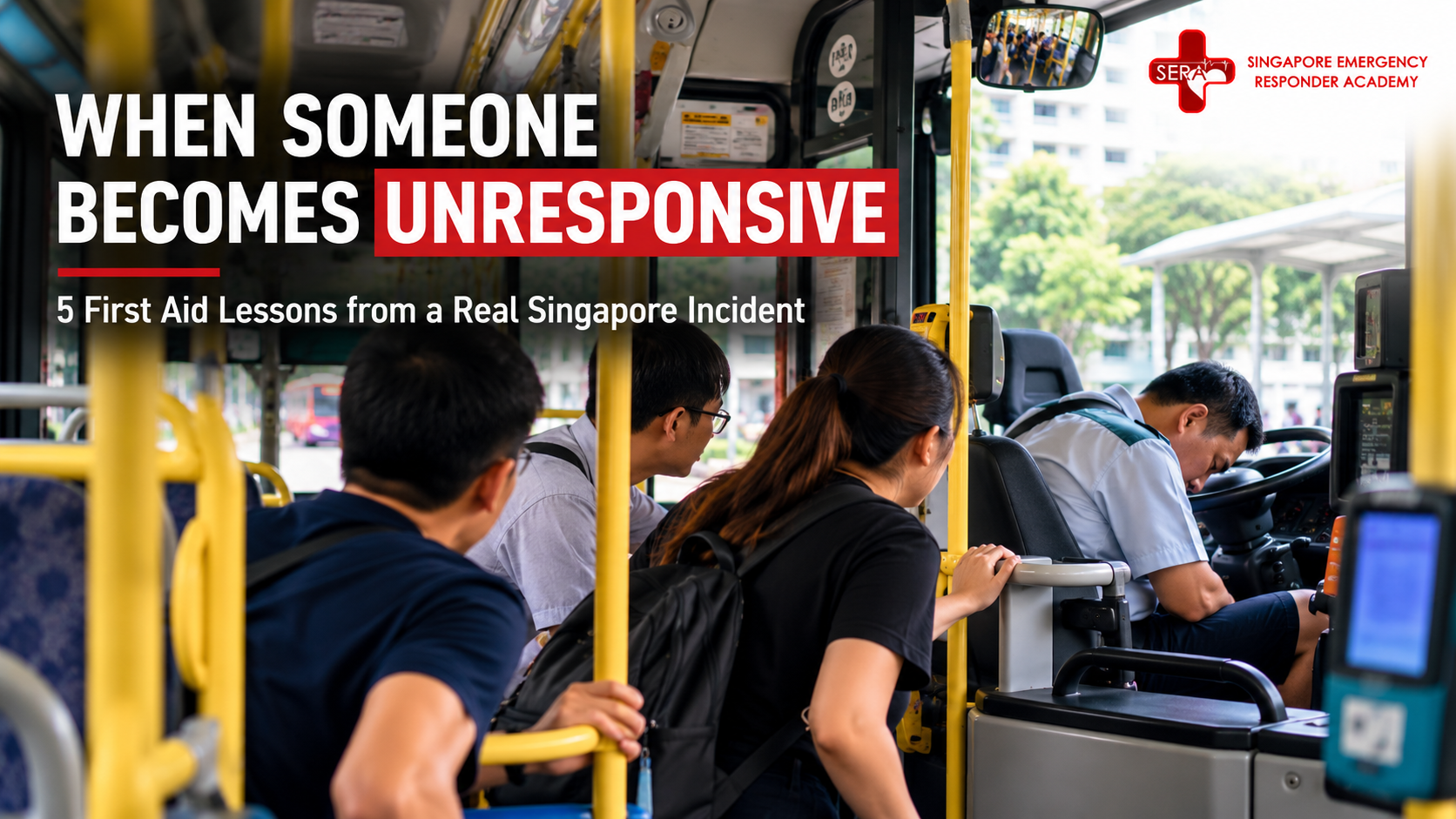
Make sure it is safe to approach. Tap the shoulders and speak loudly. If the adult is unresponsive and not breathing normally, start CPR. Occasional gasps are not normal breathing. Check breathing for no more than 10 seconds; lay rescuers should not delay for a pulse check.
Call 995 and ask for an AED
Direct a specific person to call 995 and another to retrieve an AED. If alone with a phone, call on speaker and follow the dispatcher. Give the exact location and describe the person’s condition.
Start chest compressions
Place the adult on a firm, flat surface. Stack your hands on the lower half of the breastbone, straighten your elbows and position your shoulders above your hands. Compress 4–6 cm deep at 100–120 compressions per minute, allowing full chest recoil.
If trained and able to give breaths, use 30 compressions followed by two breaths. Otherwise, perform continuous chest compressions and follow 995 instructions.
100–120/min
Recommended adult chest compression rate
Push firmly, allow the chest to recoil and minimise interruptions.
Use the AED and follow its prompts
Switch it on. Expose the chest, dry it if needed and attach the pads as illustrated. Ensure nobody touches the person during analysis or shock delivery. Deliver a shock if instructed, then immediately resume CPR. If no shock is advised, resume CPR as prompted.
Continue until the person shows signs of life and breathes normally, professionals take over, or you cannot safely continue.
These are adult instructions. Infant and child resuscitation require age-appropriate techniques. Follow your training and the emergency dispatcher’s instructions.
How practical training builds readiness
Recognising a collapse, calling for help and handling an AED can feel overwhelming. Practice gives you an opportunity to work through that sequence with an instructor.
Manikin sessions let you practise hand placement, compression technique and teamwork. AED training familiarises you with the pads and prompts before an emergency. Refresher training offers another chance to correct technique and revisit current guidance.
You can also prepare by checking AED locations at places you regularly visit. SCDF’s myResponder app helps users locate nearby AEDs and supports community first responders.
Choose a SERA course
CPR+AED
Practise hands-only CPR and AED use for adult emergencies.
BCLS+AED
Develop life support skills through practical training.
Standard First Aid
Combine CPR and AED learning with broader first aid skills.
Be ready to take the first step
Build confidence through guided practice. Explore SERA’s current course dates and registration options.
Explore CPR+AED trainingFrequently asked questions
Must I be certified before helping?
No. Call 995, follow dispatcher instructions and use the AED’s prompts. Training helps you prepare.
Does gasping count as normal breathing?
No. An unresponsive adult who is only gasping needs CPR.
Can I perform CPR without rescue breaths?
Yes. For an adult, give continuous compressions if untrained or unable to provide breaths.
Will an AED always deliver a shock?
No. It analyses the rhythm and advises a shock only when appropriate.
What does “no shock advised” mean?
It does not mean the person has recovered. Resume CPR as prompted.
How can I find a nearby AED?
Look for AED signs, ask nearby staff or use SCDF’s myResponder app.
Sources
- Alvin Ho’s story: SERA’s original article, published 1 September 2022.
- SRFAC: 2026 Singapore resuscitation guidelines
- Singapore BCLS+AED Guidelines 2026
- Singapore Heart Foundation: Adult CPR+AED
- Singapore Heart Foundation: Why learn CPR+AED
- SCDF: Emergency Medical Services and 995
- SCDF: myResponder app

Related Posts

Comments (4)
Comments are closed.


[…] how one learner applied his training in SERA’s CPR and AED learner story. It provides a real-world example of stepping forward before professional help […]
[…] with recognition; hands-on practice helps with positioning, breathing checks and teamwork. SERA’s Saving a Life with CPR and AED Skills article offers a related perspective on preparing to […]
[…] SERA’s Saving a Life with CPR and AED Skills article for a related example of training put into […]
[…] preparedness and casualty care are connected, but different competencies. SERA’s Saving a Life with CPR and AED Skills article provides a related example of practical training. A first aid course does not qualify […]