Severe bleeding can become life-threatening quickly. Learn how to recognise serious blood loss, control bleeding, identify signs of shock and respond safely while waiting for emergency medical assistance in Singapore.

Out-of-Hospital Cardiac Arrest in Singapore: Why Bystander CPR and AED Use Matter
CARDIAC ARREST · CPR + AED · SINGAPORE
What happens when someone suffers a cardiac arrest outside a hospital? In an out-of-hospital cardiac arrest (OHCA), the people already around the casualty may become a critical first link in the chain of survival.
Cardiac arrest occurs when the heart suddenly stops pumping blood effectively around the body. When this happens outside a hospital, it is known as an out-of-hospital cardiac arrest (OHCA).
It is a time-critical medical emergency. Without effective circulation, vital organs — particularly the brain — are deprived of oxygen.
The key takeaway: recognising cardiac arrest quickly, calling 995, starting CPR and using an Automated External Defibrillator (AED) as soon as possible can give a casualty a better chance of survival.
What Is an Out-of-Hospital Cardiac Arrest?
An out-of-hospital cardiac arrest refers to a cardiac arrest that occurs outside a hospital setting — for example, at home, at work, at a sports facility, in a shopping centre or in a public space.
During cardiac arrest, the heart is no longer pumping blood effectively. As a result, oxygenated blood is not adequately circulated to the brain and other vital organs.
This is why cardiac arrest requires an immediate response rather than waiting passively for professional medical assistance to arrive.
In a cardiac arrest, the question is not only how quickly an ambulance arrives. It is also what happens during the minutes before the ambulance arrives.
Cardiac Arrest in Singapore: Why Bystander Response Matters
Out-of-hospital cardiac arrest is a significant public-health challenge in Singapore.
Singapore has therefore invested in community CPR and AED readiness through programmes such as SCDF’s Community First Responder network and the myResponder app.
11,000+
AEDs registered in Singapore’s national AED repository
SCDF has reported more than 11,000 registered AEDs, with nearby AED locations available through the myResponder app.
SCDF has also reported that its Community First Responder network has grown to hundreds of thousands of registered responders, helping strengthen Singapore’s community response to time-critical emergencies.
Source: Singapore Civil Defence Force — Community Lifesaving and AED Network .
Why Is Cardiac Arrest So Time-Critical?
When the heart stops pumping effectively, blood flow to the brain and other organs is interrupted.
Without intervention, the casualty’s chance of survival decreases rapidly as time passes.
SCDF states that the chance of survival from cardiac arrest decreases by approximately 7% to 10% for every minute that passes.
7–10%
Decrease in survival chance for every minute without intervention
SCDF also states that bystander CPR has been shown to increase survival from cardiac arrest by approximately 2.2 times.
This is why immediate action by bystanders can be so important.
The goal of CPR is to help maintain blood circulation until an AED and professional medical care become available.
Cardiac Arrest vs Heart Attack: What Is the Difference?
The terms heart attack and cardiac arrest are often used interchangeably, but they describe different medical emergencies.
Heart Attack
A heart attack generally occurs when blood flow to part of the heart muscle becomes blocked. A person experiencing a heart attack may still be conscious and breathing.
Cardiac Arrest
During cardiac arrest, the heart stops pumping blood effectively. The casualty typically becomes unresponsive and is not breathing normally.
A heart attack can sometimes lead to cardiac arrest, but they are not the same condition.
Bystanders do not need to diagnose the underlying medical cause. The priority is to recognise when a casualty is unresponsive and not breathing normally and respond appropriately.
Why Do Some Bystanders Hesitate to Perform CPR?
Research and public surveys have identified several reasons why people may hesitate to help during a cardiac arrest.
Common concerns include:
- Fear of performing CPR incorrectly
- Lack of confidence in recognising cardiac arrest
- Concern about injuring the casualty
- Emotional stress during an emergency
- Uncertainty about how to use an AED
- Fear of doing something wrong in front of other people
These barriers matter because hesitation consumes time during an emergency where every minute is important.
CPR training is not only about learning the technique. It is also about developing enough familiarity and confidence to act when a real person collapses.
What Should You Do If Someone Suddenly Collapses?
If someone becomes unresponsive, follow the emergency response sequence taught during accredited CPR and first aid training.
Check for Danger and Responsiveness
Before approaching, ensure the environment is safe for you, the casualty and other people nearby.
Check whether the casualty responds.
If the person is unresponsive, treat the situation seriously and move promptly through your casualty assessment.
Call 995 and Send Someone for an AED
For a suspected cardiac arrest in Singapore, activate emergency medical assistance by calling 995.
If other people are present, delegate clearly.
Give specific instructions
Instead of simply shouting “Someone call an ambulance!”, identify someone directly:
“You — call 995. You — get the nearest AED.”
Clear instructions can help reduce confusion and ensure essential tasks happen at the same time.
Start CPR If the Casualty Is Not Breathing Normally
If the casualty is unresponsive and not breathing normally, begin CPR according to your training and follow instructions provided by the emergency medical dispatcher.
Chest compressions help maintain some circulation of blood to the brain and other vital organs while waiting for defibrillation and professional medical assistance.
Continue CPR as instructed and minimise unnecessary interruptions.
Use an AED as Soon as It Is Available
An Automated External Defibrillator (AED) is designed to analyse the casualty’s heart rhythm and determine whether a shock should be delivered.
Once the AED arrives:
- Switch on the AED.
- Follow its voice and visual prompts.
- Attach the electrode pads as indicated.
- Ensure nobody is touching the casualty when instructed.
- Deliver a shock if the AED advises one.
- Resume CPR promptly as directed by the device.
The responder does not need to diagnose the casualty’s heart rhythm. The AED performs the analysis and provides instructions.
Why CPR and AED Training Makes a Difference
Knowing intellectually that CPR should be performed is different from having practised the skill.
During hands-on training, participants learn how to:
- Recognise an unresponsive casualty
- Assess breathing
- Activate emergency medical assistance
- Perform effective chest compressions
- Use an AED safely
- Respond to choking and airway obstruction
- Work with other responders during an emergency
Repeated practice helps make the sequence more familiar so that responders have a framework to follow under pressure.
Learn CPR and AED Skills with SERA
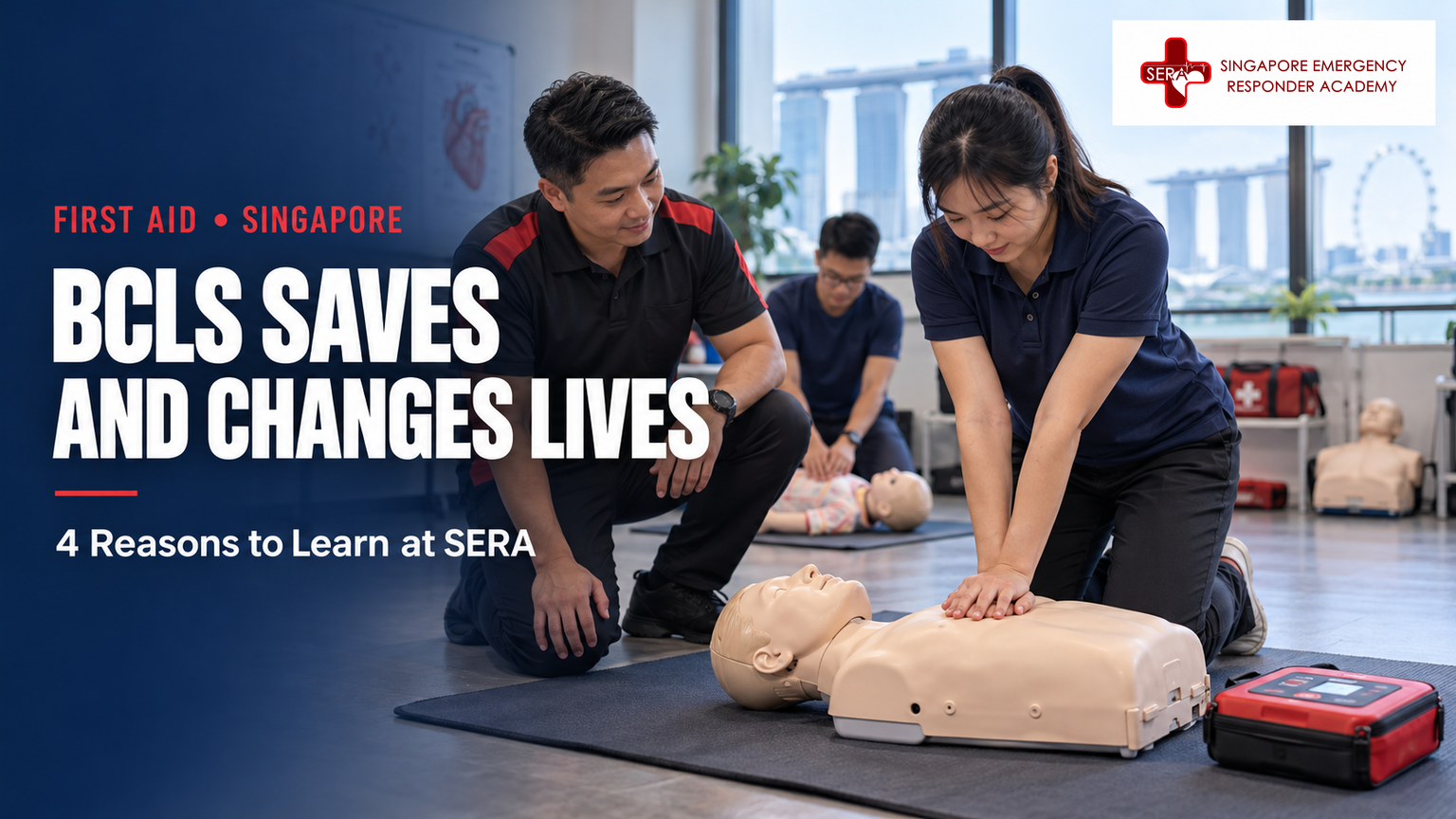
Singapore Emergency Responder Academy provides several training pathways depending on the participant’s role and required level of certification.
BCLS + AED
Develop adult, child and infant CPR, AED and foreign body airway obstruction skills.
Basic First Aid + CPR & AED
Combine basic first aid knowledge with practical CPR and AED skills.
Standard First Aid
Comprehensive first aid training that includes CPR and AED for adult casualties.
SERA’s BCLS+AED programme is conducted in accordance with the guidelines and methodologies stipulated by the Singapore Resuscitation and First Aid Council (SRFAC) and includes hands-on practical training. :chatgpt-content-reference{index=”1″}
When Every Minute Matters, Be Ready to Respond
Nobody expects a family member, colleague, customer or stranger to suddenly suffer a cardiac arrest.
But when it happens, the people already nearby may have the earliest opportunity to make a difference.
Learn to recognise cardiac arrest, perform CPR and use an AED before you are ever faced with the real thing.
Explore SERA’s BCLS + AED Course →Frequently Asked Questions About Cardiac Arrest, CPR and AEDs
What is out-of-hospital cardiac arrest?
Out-of-hospital cardiac arrest (OHCA) refers to cardiac arrest that occurs outside a hospital setting. During cardiac arrest, the heart is no longer pumping blood effectively, causing the casualty to become unresponsive and stop breathing normally.
What should I do if someone suddenly collapses in Singapore?
Ensure the scene is safe and assess the casualty. If the casualty is unresponsive and not breathing normally, call 995, begin CPR and obtain an AED as soon as possible. Follow the emergency dispatcher’s instructions and your CPR training.
How quickly should CPR be started?
CPR should begin as soon as cardiac arrest is recognised. SCDF states that a casualty’s chance of survival decreases approximately 7% to 10% for every minute that passes, making immediate bystander intervention important.
Can anyone use an AED?
AEDs are designed to provide step-by-step prompts and automatically analyse whether a shock is required. CPR and AED training gives participants practical experience using the device so they can respond more confidently during an emergency.
Is cardiac arrest the same as a heart attack?
No. A heart attack generally involves an interruption of blood flow to part of the heart muscle, while cardiac arrest occurs when the heart stops pumping blood effectively. A heart attack can sometimes lead to cardiac arrest.
Where can I learn CPR and AED in Singapore?
Singapore Emergency Responder Academy offers BCLS+AED training, as well as Basic First Aid with CPR+AED and Standard First Aid.

Related Posts