Severe bleeding can become life-threatening quickly. Learn how to recognise serious blood loss, control bleeding, identify signs of shock and respond safely while waiting for emergency medical assistance in Singapore.
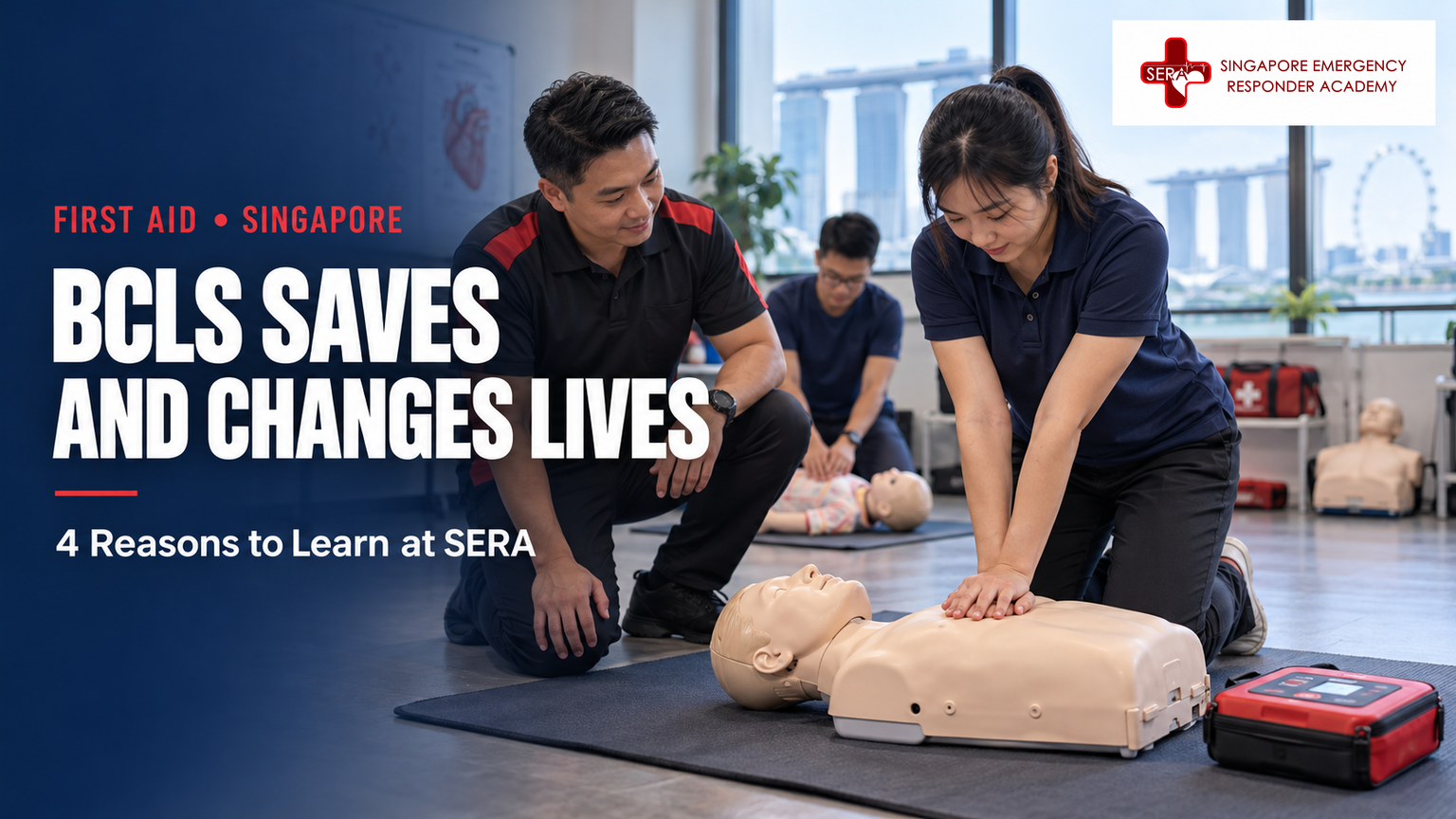
BCLS Saves and Changes Lives: 4 Reasons to Learn at SERA
BCLS+AED · Practical learning · Singapore
Originally published · Guidance reviewed
Would you know how to respond if someone collapsed or started choking? The benefits of BCLS training begin with learning what to do—and practising those actions before an emergency happens.
BCLS means Basic Cardiac Life Support. BCLS+AED combines resuscitation skills with the use of an automated external defibrillator.
At SERA, the course covers adult, child and infant CPR, AED use and relief of foreign body airway obstruction, commonly called choking. Here are four reasons to make time for this practical training.
Learn with instructor guidance
Reading about CPR is a useful starting point. Practising with an instructor gives you the opportunity to ask questions and receive feedback on your technique.
Hand position, posture and the way you release pressure between compressions all matter. A guided session lets you work on these details while learning how the actions fit together.
Use that time actively: ask about anything you find confusing, repeat unfamiliar movements and explain the response sequence in your own words. The aim is to leave with a clearer understanding of your role.
Fit theory learning around your schedule
SERA’s blended BCLS+AED course currently lists approximately four hours of online learning, followed by four contact hours of onsite practical training and theory assessment.
Online theory gives you space to study before attending the practical session. Set aside focused time, take notes and bring your questions to class.
Blended learning still includes in-person practice
SRFAC requires hands-on practice and assessments to take place in the instructor’s presence. Completing online theory alone does not replace the practical component.
Turn information into hands-on skills
Practical sessions give you a chance to move through the response: recognise the problem, call for help, begin the appropriate action and use equipment.
Manikin practice provides a setting for repetition. AED training lets you become familiar with the device’s prompts and pad placement. Practising alongside others also helps you think about communication and sharing tasks.
For example, rehearse giving a clear instruction to a bystander: call 995, retrieve an AED or guide the ambulance crew to the location. Simple, specific requests help organise a response.
Prepare to help before professionals arrive
BCLS training helps you recognise situations that need urgent action. For an unresponsive adult who is not breathing normally, including someone who is only gasping, call 995 and begin CPR. Ask another person to retrieve an AED.
The 2026 Singapore guidelines recommend adult compressions at 100–120 per minute, 4–6 cm deep, with full chest recoil. Follow the AED and dispatcher’s instructions.
Choking requires a different response. Someone coughing effectively should be encouraged to cough and monitored. Severe obstruction needs immediate age-appropriate intervention. Learning to recognise the difference is part of preparation.
Explore SERA’s guides to partial airway obstruction and complete airway obstruction.
995
Call for a life-threatening emergency in Singapore
Put your phone on speaker and follow the dispatcher. Give the exact location and describe what has happened.
Who should consider BCLS training?
BCLS+AED may suit healthcare personnel, caregivers, parents and others seeking broader resuscitation skills. If you need certification for work, check your employer’s requirements before choosing a course.
For an adult hands-only CPR and AED focus, consider CPR+AED. For broader everyday injury and illness response, explore Standard First Aid.
Keep your skills ready after the course
Review your learning, plan refresher training and check AED locations at places you regularly visit. SCDF’s myResponder app helps users locate nearby AEDs and supports community first responders.
Read how one learner applied his training in SERA’s CPR and AED learner story. It provides a real-world example of stepping forward before professional help arrives.
Training prepares you to help; it cannot guarantee an outcome. In an emergency, call 995 and follow the dispatcher’s instructions. You do not need certification before offering dispatcher-guided assistance.
Explore relevant SERA courses
BCLS+AED
Practise resuscitation, AED use and choking response.
CPR+AED
Learn adult hands-only CPR and AED use.
Standard First Aid
Build broader first aid skills alongside CPR and AED learning.
Take the next step towards readiness
Explore upcoming BCLS+AED sessions and current registration details at SERA.
View BCLS+AED course detailsFrequently asked questions
What does BCLS stand for?
BCLS stands for Basic Cardiac Life Support.
Is BCLS+AED the same as CPR+AED?
No. BCLS+AED has a broader resuscitation scope. CPR+AED focuses on adult hands-only CPR and AED use.
Can I complete accredited BCLS training entirely online?
No. Online theory must be followed by in-person practical training and assessments.
How long is SERA’s BCLS+AED certificate valid?
The course page states two years from completion.
Should I check workplace requirements before enrolling?
Yes. Confirm which course and certification your employer requires.
Can I help if I am not certified?
Yes. Call 995, follow dispatcher instructions and use the AED’s prompts. Training helps you prepare.
Sources

Related Posts


