
Choking can become life-threatening when the airway is completely blocked. Learn how to recognise complete airway obstruction and what to do if an adult, child or infant is unable to speak, breathe or cough effectively.
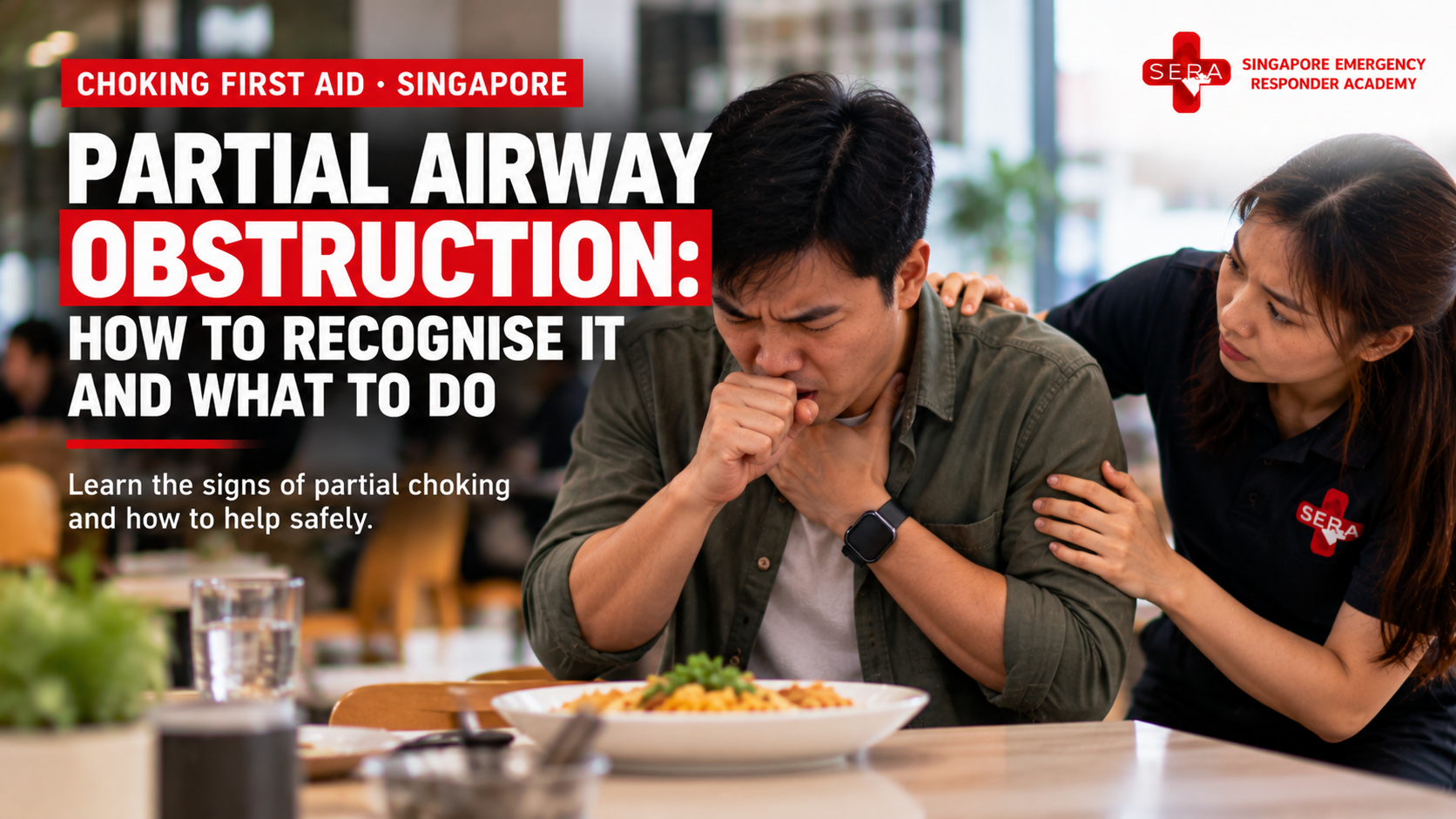
Partial Airway Obstruction: How to Recognise It and What to Do
CHOKING FIRST AID · FBAO · SINGAPORE
Someone starts choking during a meal — but they can still cough. What should you do? If the casualty can still cough effectively, breathe or make sounds, they may have a partial airway obstruction.
Choking occurs when food or another foreign object enters and obstructs the airway. In first aid and resuscitation training, this is known as a Foreign Body Airway Obstruction (FBAO).
FBAO can be either partial or complete. Knowing the difference is important because the appropriate first aid response is not the same.
The key takeaway: if a casualty with a partial obstruction is coughing effectively, do not interfere with the cough. Encourage them to continue coughing and monitor carefully for signs that the obstruction is becoming more severe.
What Is a Partial Airway Obstruction?
A partial airway obstruction occurs when a foreign object blocks part — but not all — of the airway.
Because some air can still move through the airway, the casualty may remain able to cough, breathe or produce sounds.
Their breathing may sound noisy or strained, and they may understandably appear frightened or distressed.
However, an effective cough is important: coughing is the body’s natural mechanism for attempting to expel an object from the airway.
If the casualty can cough effectively, allow them to cough. Your role is to monitor them closely and be ready to act if their condition deteriorates.
Partial vs Complete Airway Obstruction: What’s the Difference?
Recognising whether the obstruction is partial or complete determines what you should do next.
Partial Airway Obstruction
The casualty may still be able to:
- Cough effectively
- Breathe
- Speak or produce sounds
Response: allow the casualty to continue coughing and monitor for deterioration.
Complete Airway Obstruction
The casualty may be:
- Unable to speak
- Unable to breathe
- Unable to cough effectively
- Clutching their neck
- Showing increasing distress
Response: immediate first aid intervention is required.
According to Singapore Resuscitation and First Aid Council (SRFAC) guidance, a casualty who is coughing effectively has a partially obstructed airway, while someone with complete obstruction is unable to speak, breathe or cough effectively.
Let the Casualty Continue Coughing
If the casualty is coughing effectively, do not interfere unnecessarily.
Allow and encourage them to continue coughing in an attempt to expel the foreign object themselves.
Stay with the casualty. Do not assume that because they can currently breathe or cough, the situation cannot become more serious.
Why coughing matters
Coughing generates pressure and airflow that may help move the foreign object out of the airway. SRFAC describes coughing as the body’s natural defence against airway obstruction.
Monitor for Signs of Deterioration
A partial obstruction can progress to a complete obstruction.
While the casualty is coughing, continue watching and listening for changes in their condition.
Be alert if they become:
- Unable to produce sounds
- Unable to breathe
- Unable to cough effectively
- Increasingly distressed
- Unable to clear the obstruction despite repeated attempts
A casualty who loses the ability to speak, breathe or cough effectively should be treated as having a complete airway obstruction.
Do Not Give Food or Water
One instinctive response may be to offer the casualty water in an attempt to “wash down” the obstruction.
Do not do this.
Avoid giving the choking casualty additional food or water.
Singapore paediatric resuscitation guidance specifically advises against feeding a casualty more water or food while attempting to clear an airway obstruction.
Focus instead on allowing an effective cough to continue while monitoring the casualty.
Do Not Shake the Casualty or Interfere With an Effective Cough
Seeing someone choke can be frightening, and the instinct may be to immediately start hitting, shaking or otherwise intervening.
However, when the casualty is still coughing effectively, Singapore guidance is clear: do not interfere with the casualty’s attempt to clear the obstruction by coughing.
SRFAC’s paediatric guidance also advises against shaking the casualty in an attempt to dislodge the foreign body.
Doing more is not always better first aid. With a partial airway obstruction, recognising an effective cough and knowing when not to interfere are important skills too.
Know When the Situation Has Become an Emergency
Continue monitoring the casualty while they attempt to clear the obstruction.
Singapore paediatric resuscitation guidance advises considering a call to 995 for SCDF if repeated attempts by the casualty to clear the airway are unsuccessful.
If the casualty deteriorates and becomes unable to speak, breathe or cough effectively, the obstruction should be treated as complete and immediate action is required.
PARTIAL → COMPLETE
A choking casualty’s condition can deteriorate.
Continue monitoring until the foreign object is cleared. If the casualty can no longer speak, breathe or cough effectively, they require a different and more urgent first aid response.
Read SERA’s companion guide: Complete Airway Obstruction: What to Do When Someone Is Choking .
What If the Casualty Clears the Obstruction?
If coughing successfully expels the foreign object, reassess the casualty and ensure they are breathing normally and recovering.
Do not simply assume that everything is fine if they continue to have symptoms.
Consider seeking medical attention if the casualty:
- Continues to have difficulty breathing
- Has persistent coughing or wheezing
- Feels that something remains lodged in the airway
- Develops persistent pain or discomfort
- Appears unwell after the choking episode
What If the Casualty Becomes Completely Choked?
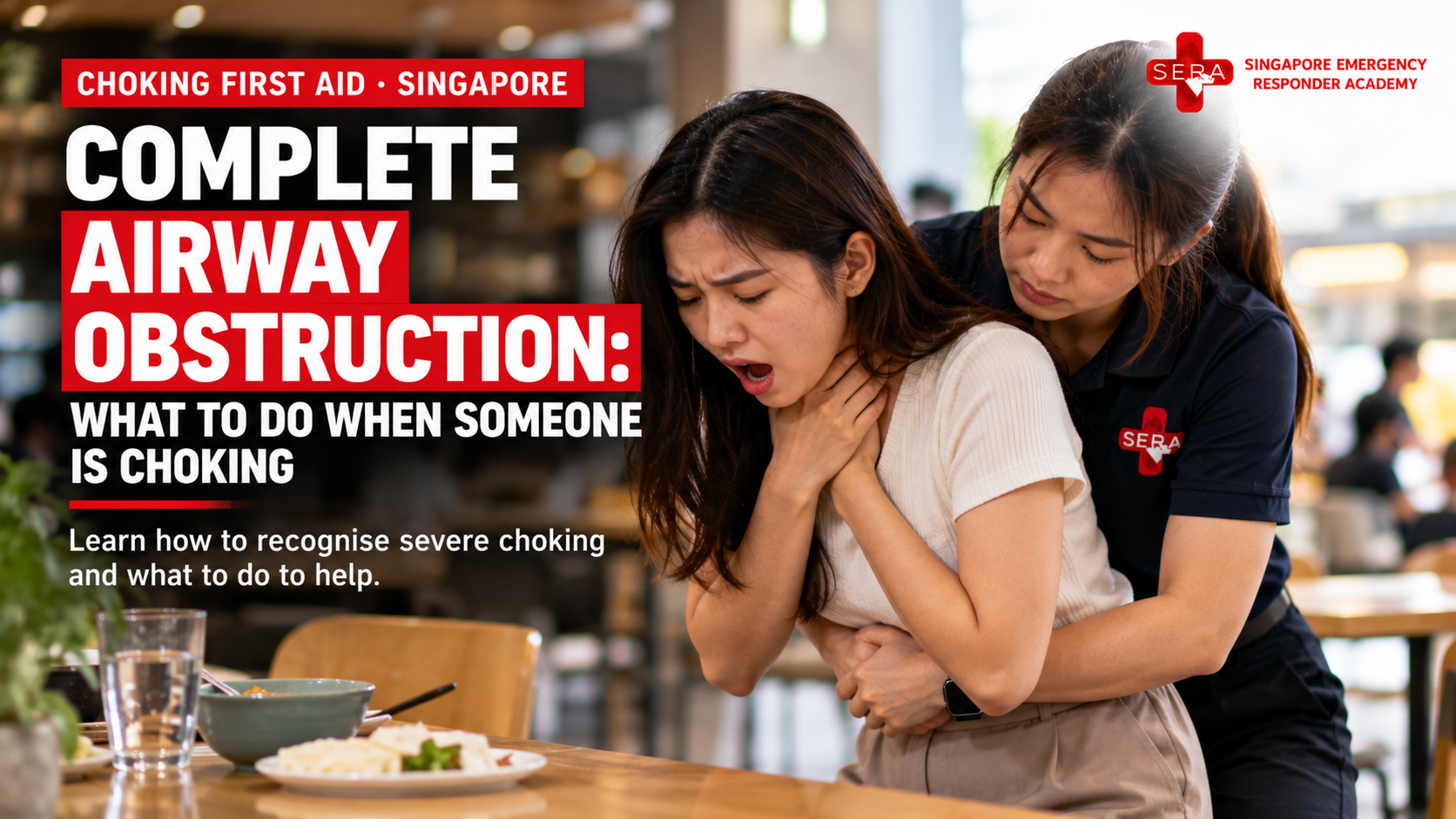
If the casualty can no longer speak, breathe or cough effectively, the situation has progressed from a partial to a complete airway obstruction.
The appropriate response then depends on the casualty’s age and condition.
For example, Singapore resuscitation guidance recommends abdominal thrusts for responsive adults and children with complete FBAO, while chest thrusts are used for responsive pregnant or obese casualties. Infant choking requires a different technique involving back blows and chest thrusts.
If a choking casualty becomes unconscious, activate emergency medical assistance by calling 995 and begin the appropriate resuscitation response according to your training and the emergency dispatcher’s instructions.
Why Choking First Aid Training Matters
Choking can happen suddenly at home, at work, in restaurants, at schools or while caring for young children.
The challenge is not simply remembering one manoeuvre.
A trained responder needs to recognise:
- Whether an airway obstruction is partial or complete
- Whether a cough is effective
- When to monitor instead of interfering
- When active choking first aid is required
- How techniques differ for adults, children and infants
- What to do if the casualty becomes unconscious
Hands-on training allows participants to practise these decisions and techniques in a controlled environment before facing a real emergency.
Learn Choking, CPR and First Aid Skills with SERA
Singapore Emergency Responder Academy provides practical resuscitation and first aid training covering foreign body airway obstruction and other life-threatening emergencies.
BCLS + AED
Learn CPR, AED use and foreign body airway obstruction management for adults, children and infants.
Standard First Aid
Develop broader first aid skills alongside CPR, AED and choking management.
Child First Aid
Build practical first aid and emergency-response skills relevant to infants and children.
Know When to Act — and When to Let Them Cough
Effective first aid is not always about immediately performing a procedure.
When someone has a partial airway obstruction and is coughing effectively, knowing how to recognise the situation, monitor for deterioration and avoid unnecessary intervention is equally important.
Learn to recognise the difference before you are faced with a real choking emergency.
Explore SERA’s BCLS + AED Course →Frequently Asked Questions About Partial Airway Obstruction
What is a partial airway obstruction?
A partial airway obstruction occurs when a foreign object blocks part of the airway but some airflow remains. The casualty may still be able to cough, breathe or produce sounds.
What should I do if someone is choking but can still cough?
If the casualty is coughing effectively, allow and encourage them to continue coughing. Do not unnecessarily interfere. Stay with them and monitor carefully for signs that the obstruction is becoming complete.
Should I give a choking person water?
No. Do not give additional food or water to a casualty who is choking. Allow an effective cough to continue and monitor their condition.
Should I perform abdominal thrusts for partial choking?
If the casualty is coughing effectively, Singapore resuscitation guidance recommends not interfering and allowing them to attempt to expel the foreign object by coughing. Abdominal thrusts are recommended for responsive adults and children with complete airway obstruction.
How do I know if partial choking has become complete choking?
A complete airway obstruction should be suspected if the casualty becomes unable to speak, breathe or cough effectively. This requires immediate first aid intervention.
When should I call 995 for choking?
Consider calling 995 if repeated attempts by the casualty to clear the obstruction are unsuccessful. If the casualty becomes unconscious, activate emergency medical assistance immediately and follow the SCDF dispatcher’s instructions.
Where can I learn choking first aid in Singapore?
Singapore Emergency Responder Academy offers BCLS+AED, Standard First Aid and Child First Aid training.

Related Posts
Comments (2)
Comments are closed.


[…] our focused guides to partial airway obstruction: recognition and help and complete airway obstruction: ways to […]
[…] SERA’s guides to partial airway obstruction and complete airway […]