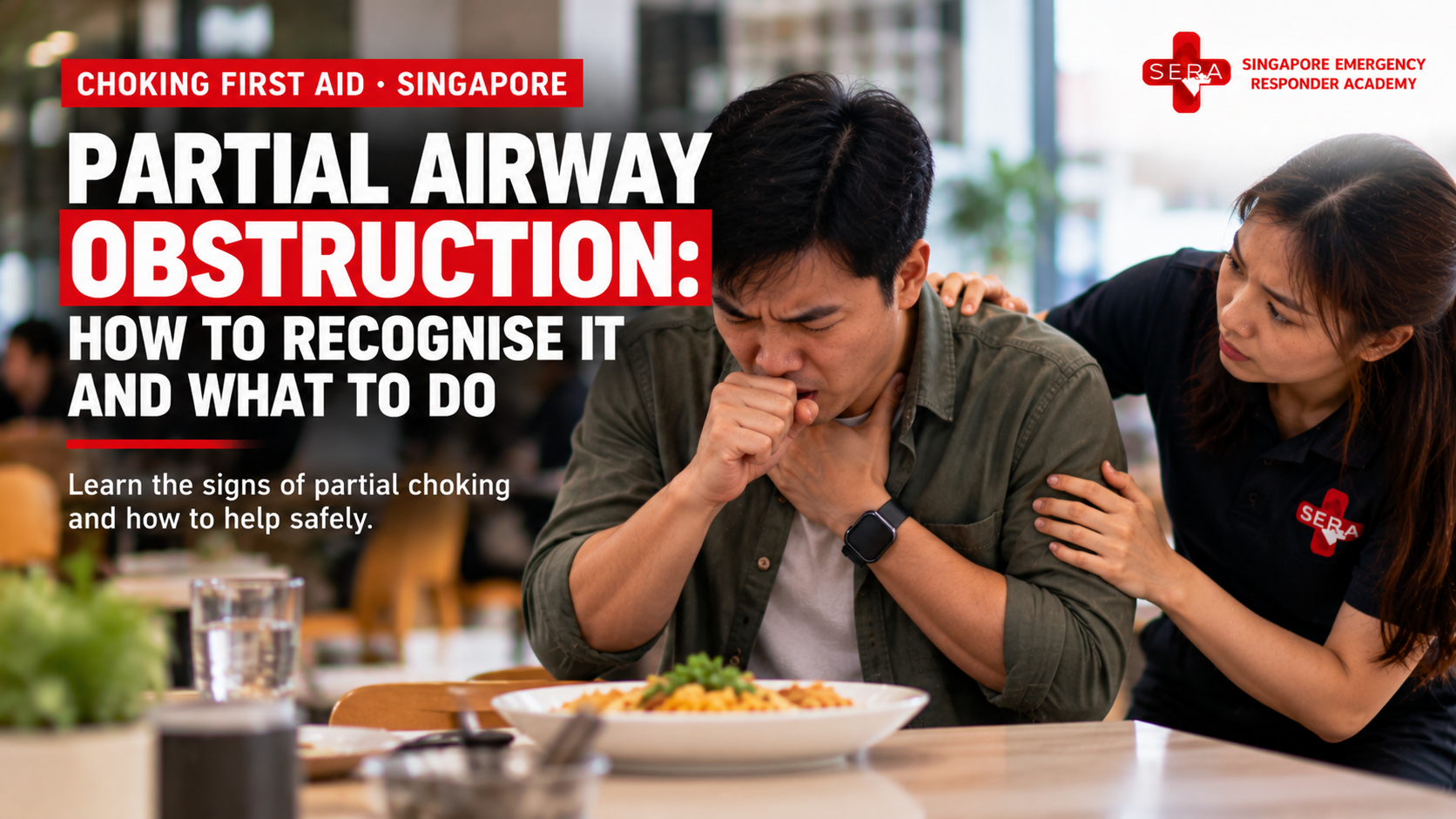
A person who is choking but can still cough, breathe or make sounds may have a partial airway obstruction. Learn how to recognise the signs, what you should do, what to avoid and when the situation becomes an emergency.
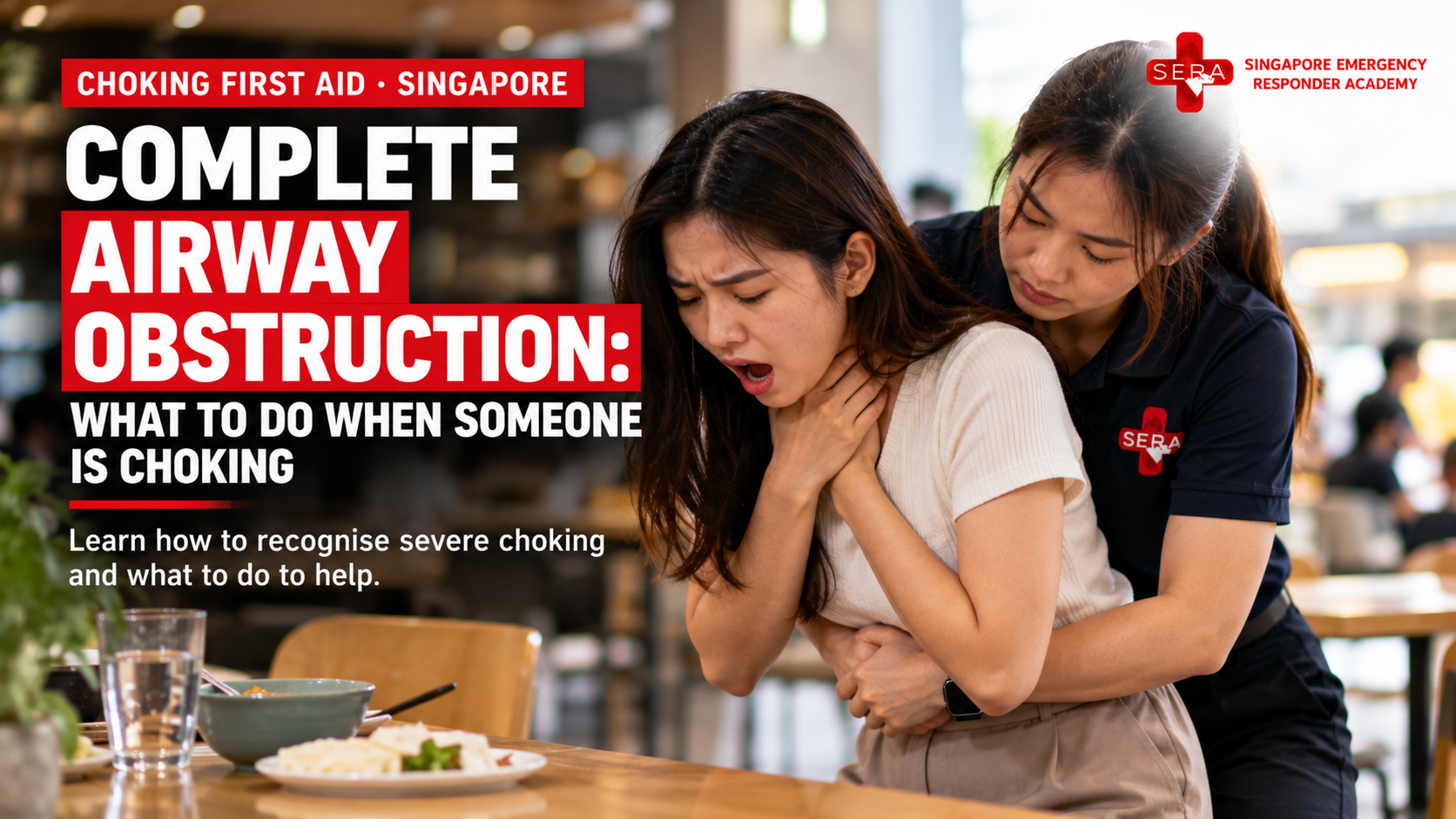
Complete Airway Obstruction: What to Do When Someone Is Choking
CHOKING FIRST AID · FBAO · SINGAPORE
What should you do if someone is choking and suddenly cannot speak, breathe or cough? A complete airway obstruction can become life-threatening within minutes, making early recognition and immediate action critical.
Choking occurs when a foreign object blocks the airway. In first aid and resuscitation training, this is known as a Foreign Body Airway Obstruction (FBAO).
A partial obstruction may still allow the casualty to cough or make sounds. A complete or severe airway obstruction is different: the casualty may be unable to speak, breathe or cough effectively.
The key takeaway: recognise severe choking quickly, act according to the casualty’s age and condition, and call 995 if the casualty becomes unconscious or the situation requires emergency medical assistance.
What Is a Complete Airway Obstruction?
A complete airway obstruction occurs when a foreign object prevents air from moving effectively through the casualty’s airway.
Food is a common cause, but choking can also occur when small objects accidentally enter the airway.
Singapore Resuscitation and First Aid Council (SRFAC) guidance describes complete airway obstruction as a situation where the casualty is unable to speak, breathe or cough effectively.
Because oxygen cannot move normally into the lungs, severe choking requires immediate attention.
The most important first step is recognising the difference between someone who can still cough effectively and someone whose airway is severely obstructed.
Partial vs Complete Airway Obstruction: How Can You Tell?
Partial Airway Obstruction
The casualty may still be able to:
- Cough effectively
- Breathe
- Speak or make sounds
If the casualty is coughing effectively, encourage them to continue coughing and monitor for deterioration.
Complete Airway Obstruction
The casualty may be:
- Unable to speak
- Unable to breathe normally
- Unable to cough effectively
- Clutching their throat
- Showing increasing distress
This requires immediate first aid intervention.
Do not interfere with an effective cough.
SRFAC guidance recommends allowing a casualty with a partial airway obstruction to continue coughing to try to expel the object. Continue monitoring because a partial obstruction can deteriorate into a complete obstruction.
What Is the Universal Choking Sign?
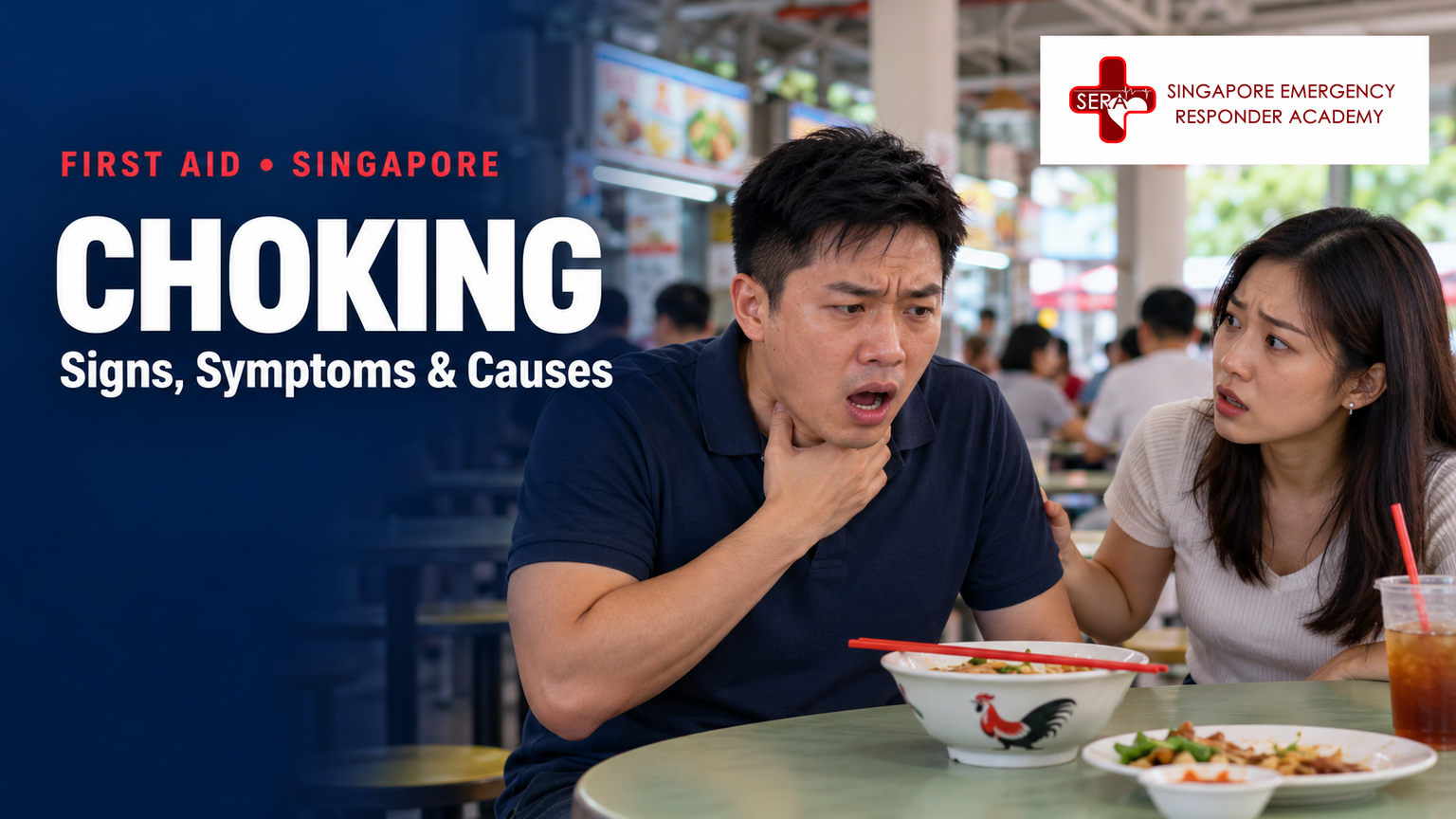
A person who is choking may instinctively clutch their neck with one or both hands.
This is commonly recognised as the universal choking sign.
However, do not rely on this gesture alone. Look at whether the casualty can speak, breathe or cough effectively.
A casualty with a complete obstruction may be unable to answer you even when they are still conscious.
Recognise Severe Choking
If the casualty cannot speak, breathe or cough effectively, treat the situation as a severe or complete airway obstruction.
Act promptly rather than waiting to see whether the obstruction clears on its own.
The appropriate technique depends on whether the casualty is:
- An adult or child
- Pregnant
- Obese
- An infant
- Conscious or unconscious
For a Conscious Adult or Child: Perform Abdominal Thrusts
For a responsive adult or child with a complete airway obstruction, Singapore resuscitation guidance recommends abdominal thrusts.
Abdominal thrusts — sometimes referred to as the Heimlich manoeuvre — rapidly increase pressure inside the abdomen and chest in an attempt to create enough airflow to expel the foreign object.
Continue according to your first aid training until:
- The foreign object is expelled; or
- The casualty becomes unconscious.
Why practical training matters
The effectiveness and safety of abdominal thrusts depend on correct positioning and technique. Hands-on first aid or BCLS+AED training allows participants to practise the procedure using training equipment rather than trying to learn it for the first time during a real choking emergency.
For a Pregnant or Obese Casualty: Use Chest Thrusts
Abdominal thrusts may not be appropriate for every casualty.
For a responsive casualty who is pregnant or obese, Singapore guidance recommends using chest thrusts instead.
Continue the appropriate thrusts until the obstruction is relieved or the casualty becomes unconscious.
For a Choking Infant: Use Back Blows and Chest Thrusts
The choking response for an infant is different from the technique used for an adult or older child.
For a conscious infant with severe foreign body airway obstruction, Singapore paediatric resuscitation guidance recommends:
- Positioning the infant securely with the head supported and lower than the body.
- Delivering 5 back blows.
- Following with 5 chest thrusts.
- Repeating as required until the object is expelled or the infant becomes unconscious.
Do not perform abdominal thrusts on an infant.
Infant choking requires an age-appropriate technique using back blows and chest thrusts.
If the Casualty Becomes Unconscious: Call 995 and Begin the Appropriate Response
If a choking casualty becomes unconscious, the emergency has escalated.
Support the casualty and place them safely on a firm, flat surface.
Shout for help and have someone call 995. Follow the instructions provided by the SCDF emergency medical dispatcher.
Singapore guidance for unconscious foreign body airway obstruction includes beginning 30 chest compressions, checking the airway for a visible foreign object and continuing the appropriate resuscitation sequence according to your training and dispatcher instructions.
995
Singapore’s emergency medical services number
SCDF operates a 24-hour Emergency Medical Service for medical emergencies. Stay calm, provide the casualty’s location and condition, and follow the call-taker’s instructions.
Learn more from Singapore Civil Defence Force — Emergency Medical Services .
Should You Perform a Blind Finger Sweep?
No. Do not blindly sweep your fingers through a choking casualty’s mouth.
When managing an unconscious choking casualty, Singapore resuscitation guidance calls for checking the mouth for a visible foreign object during the appropriate airway sequence.
Attempting to remove an object that cannot be seen may push it deeper into the airway.
What Should You Do After the Object Comes Out?
Once the foreign object has been expelled, reassess the casualty.
Check whether they are breathing normally and whether their condition has returned to normal.
A casualty may still require medical assessment, particularly if they:
- Lost consciousness
- Continue to have difficulty breathing
- Have persistent coughing or discomfort
- Received significant abdominal or chest thrusts
- Appear unwell after the obstruction has cleared
If you are concerned about the casualty’s condition or it remains a medical emergency, seek professional medical assistance.
Why Choking First Aid Training Matters
Choking emergencies can develop suddenly — during a family meal, at a restaurant, in a workplace pantry, at school or while caring for a young child.
The response also changes according to the casualty.
A responder needs to know the difference between:
- Partial and complete airway obstruction
- Adult and child choking
- Infant choking
- Choking in a pregnant or obese casualty
- A conscious and unconscious casualty
Practical training gives participants an opportunity to recognise these differences and practise the correct techniques before they encounter a real emergency.
Learn Choking, CPR and AED Skills with SERA
Singapore Emergency Responder Academy provides practical resuscitation and first aid programmes that include recognition and management of foreign body airway obstruction.
BCLS + AED
Learn CPR, AED use and foreign body airway obstruction management for adults, children and infants.
Standard First Aid
Develop broader first aid skills alongside CPR, AED and choking management.
Occupational First Aid
Practical first aid and emergency-response training for appointed workplace first aiders.
Know What to Do Before Someone Chokes
A choking emergency can progress quickly, and a casualty with a completely obstructed airway may be unable to tell you what is wrong.
Knowing how to recognise severe choking — and how the response differs for adults, children and infants — can give you a clear framework to follow when immediate action is required.
Learn the technique before you ever need to use it.
Explore SERA’s BCLS + AED Course →Frequently Asked Questions About Choking and Complete Airway Obstruction
How do I know if someone has a complete airway obstruction?
A casualty with a complete or severe foreign body airway obstruction may be unable to speak, breathe or cough effectively. They may also clutch their throat and show obvious distress.
Should I hit someone on the back if they are coughing?
If the casualty has a partial obstruction and is coughing effectively, Singapore resuscitation guidance recommends allowing them to continue coughing while monitoring for deterioration rather than interfering with an effective cough.
What should I do if an adult is choking and cannot breathe?
For a responsive adult with complete airway obstruction, abdominal thrusts are recommended. Continue according to your training until the foreign body is expelled or the casualty becomes unconscious. If the casualty becomes unconscious, call 995 and begin the appropriate unconscious FBAO response.
What should I do if a pregnant person is choking?
For a responsive pregnant casualty with complete airway obstruction, chest thrusts are recommended instead of abdominal thrusts.
What should I do if a baby is choking?
For a conscious infant with severe airway obstruction, Singapore paediatric resuscitation guidance recommends cycles of five back blows followed by five chest thrusts until the foreign body is expelled or the infant becomes unconscious.
When should I call 995 for choking?
If a choking casualty becomes unconscious, call 995 immediately and begin the appropriate resuscitation response. For any life-threatening medical emergency, follow SCDF’s instructions while emergency medical assistance is dispatched.
Where can I learn choking first aid in Singapore?
Singapore Emergency Responder Academy offers BCLS+AED, Standard First Aid and Occupational First Aid training.

Related Posts
Comments (2)
Comments are closed.


[…] Read SERA’s companion guide: Complete Airway Obstruction: What to Do When Someone Is Choking . […]
[…] Read our focused guides to partial airway obstruction: recognition and help and complete airway obstruction: ways to help. […]