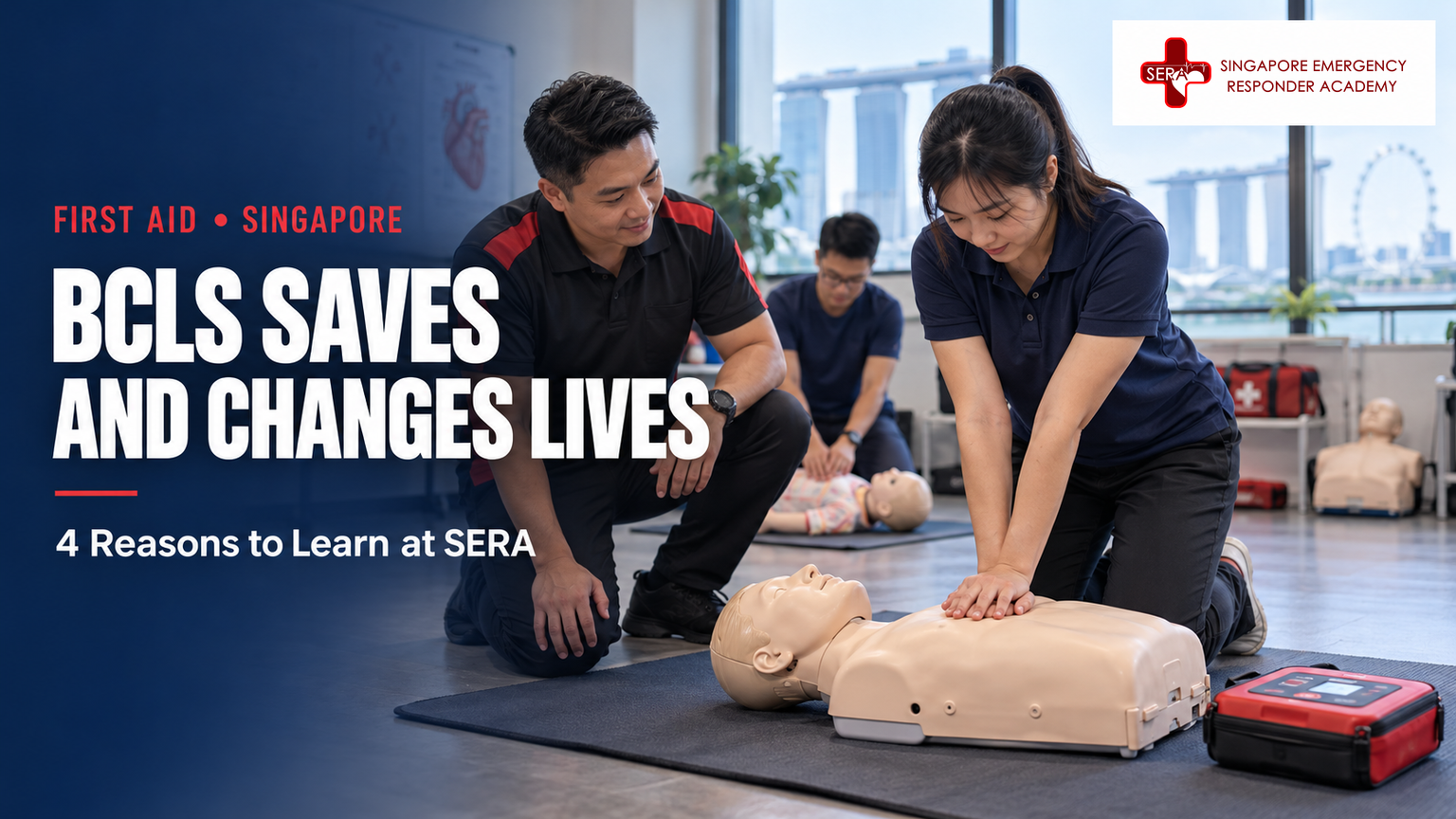
When someone suffers a cardiac arrest, every minute matters. Learn why immediate bystander CPR and AED use are critical, what to do if someone suddenly collapses, and how CPR training can help save lives in Singapore.
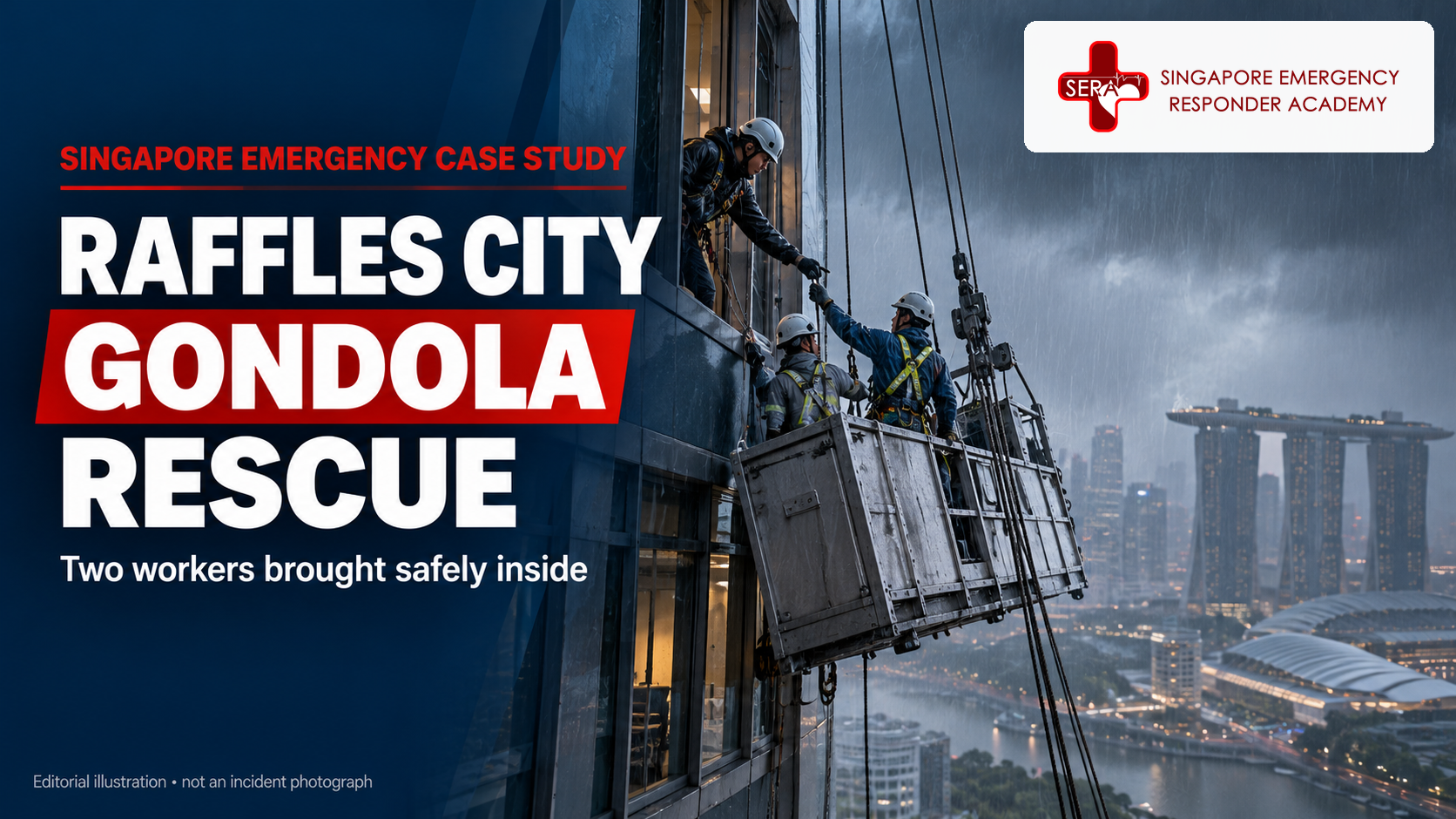
Raffles City Gondola Rescue: What Singapore’s High-Rise Emergency Teaches Us
Real-Life Emergency Response | Singapore Case Study
On 21 July 2025, two workers were stranded high above the ground after their suspended work platform tilted outside Raffles City Tower in Singapore. A coordinated rescue involving the Singapore Civil Defence Force (SCDF) brought both workers safely into the building.
The key takeaway:
Emergency preparedness is not only about
providing first aid after an injury.
In high-risk environments, recognising danger,
activating professional rescuers, protecting
bystanders and communicating clearly can
prevent an incident from becoming a tragedy.
The Raffles City gondola rescue demonstrates how workplace emergency planning and specialist rescue capabilities work together during a potentially life-threatening situation.
What Happened at Raffles City Tower?
At approximately 11.20am on 21 July 2025, two workers were carrying out routine façade resealant work at Raffles City Tower, 250 North Bridge Road.
According to statements reported by The Straits Times , the weather changed suddenly and an immediate stop-work order was issued.
While the gondola was being retracted, it tilted to one side, leaving both workers stranded high above the ground.
Building management stated that the supporting ropes remained intact. The workers were also wearing safety harnesses when the incident occurred.
SCDF was activated to conduct a height rescue. Its firefighters and Disaster Assistance and Rescue Team (DART) responded to the scene.
2 Workers Rescued
The workers were brought safely into the building through windows on the 29th and 30th floors. Both were assessed by an SCDF paramedic and conveyed to hospital in stable condition.
How Did SCDF Rescue the Stranded Workers?
SCDF’s official account, 30 Storeys High: SCDF Rescues Two from a Gondola , describes a coordinated rescue involving DART, Kallang Fire Station and Central Fire Station.
On arrival, firefighters assessed the gondola’s stability and checked the condition of the workers.
The situation was complicated by heavy rain and strong winds, which caused the gondola to sway and occasionally strike the building’s windows.
Police officers cordoned off the area below to protect people from potential falling objects.
Rescuers established secure anchor points inside the building and deployed specialist rescue equipment.
A DART specialist then accessed the gondola through a window. Working together, the rescue teams brought the workers into the building through separate windows on the 29th and 30th floors.
SCDF reported that the final extraction was completed within approximately 20 minutes. Both workers were assessed and conveyed to hospital in stable condition.
Confirmed outcome:
Both workers were successfully rescued.
The building’s management reported that
initial checks did not indicate injuries.
The official accounts do not establish
the mechanical cause of the gondola’s tilt
or the workers’ longer-term medical outcomes.
Five Emergency-Response Lessons From the Incident
The following lessons are general safety and first aid recommendations informed by the incident and official Singapore workplace safety guidance. They should not be interpreted as additional actions performed during the rescue.
01
Recognise When Specialist Rescue Is Required
A suspended worker or unstable work platform presents serious fall risks. Workers and bystanders should not attempt improvised rope rescues or climb onto unstable equipment. Activate the site’s emergency procedures and call 995 when professional rescue assistance is required.
02
Prevent Additional Casualties
Before approaching any emergency, assess the surrounding hazards. Keep people away from areas where tools, equipment or other objects could fall. Do not enter a hazardous exclusion zone without appropriate authorisation and protection.
03
Prepare Emergency Arrangements Before Work Begins
The Workplace Safety and Health Council recommends that work-at-height planning include emergency response arrangements. Employers should review equipment condition, weather-related risks, communication methods and suitable rescue procedures before authorising work.
04
Communicate Clearly During an Emergency
SCDF described how its rescuers reassured the stranded workers using hand gestures when ordinary verbal communication was difficult. Simple, calm instructions can help reduce confusion while trained personnel coordinate the rescue.
05
Arrange Medical Assessment After Rescue
A person rescued from a dangerous situation may still require medical assessment, even when injuries are not immediately obvious. Monitor the casualty, follow professional instructions and arrange appropriate care. Provide first aid only when the scene is safe.
What Should Employers Review After a Height-Rescue Incident?
Singapore’s WSH Council guidance on preventing falls emphasises risk control, safe work procedures, fall protection, training and emergency planning.
For suspended scaffolds and gondolas, employers should also consult MOM’s circular on safe design and installation of suspended scaffold supports .
Workplace emergency-readiness checklist:
- Review site-specific work-at-height risk assessments.
- Verify relevant equipment inspections and maintenance.
- Establish appropriate emergency rescue procedures.
- Identify trained personnel and emergency contacts.
- Plan for adverse weather and safe suspension of work.
- Ensure appointed first aiders are available where required.
- Practise emergency communication and responder access.
How Does First Aid Support Workplace Rescue?
First aid training does not qualify someone to perform technical height rescues. Those operations require specialist equipment, competence and procedures.
However, trained first aiders can support emergency preparedness by recognising medical emergencies, activating help and caring for casualties once they can be reached safely.
SCDF advises callers to provide their location, describe the emergency clearly and follow the instructions given by its 995 Operations Centre Specialists.
Relevant SERA First Aid Training
Occupational First Aid
Develop the practical skills required to respond to common workplace injuries and medical emergencies.
Explore Occupational First Aid →CERT First Aid
Build first aid, CPR and AED skills that support organised workplace emergency-response arrangements.
Explore CERT First Aid →Standard First Aid
Learn essential first aid techniques for common injuries and sudden medical emergencies.
Explore Standard First Aid →Strengthen Your Organisation’s Emergency Readiness
Effective workplace safety involves preventing accidents and preparing for emergencies.
Singapore Emergency Responder Academy provides practical first aid and emergency-response training for individuals and corporate groups.
Request Corporate TrainingFrequently Asked Questions
1. When did the Raffles City gondola incident happen?
The incident occurred on 21 July 2025 at Raffles City Tower, 250 North Bridge Road, Singapore.
2. How many workers were rescued?
SCDF rescued two workers stranded on a tilted gondola outside the building.
3. Were the workers injured?
Both workers were conveyed to hospital in stable condition. Building management reported that initial checks did not indicate injuries.
4. Who carried out the rescue?
SCDF’s Disaster Assistance and Rescue Team worked with firefighters from Kallang and Central Fire Stations.
5. Should bystanders attempt to rescue suspended workers?
Bystanders should not attempt improvised height rescues. Keep a safe distance, activate emergency procedures and call 995 for specialist assistance.
6. Does first aid training include technical rope rescue?
No. Standard first aid training does not qualify participants to conduct technical rope or high-angle rescue operations.
7. What can employers learn from this incident?
Employers should prioritise work-at-height risk controls, equipment safety, weather-related precautions, emergency planning and trained responders.
Official Sources and Further Reading
- SCDF — 30 Storeys High: SCDF Rescues Two from a Gondola
- The Straits Times — Raffles City Tower Rescue, 21 July 2025
- WSH Council — Preventing Falls from Heights
- MOM — Safe Design and Installation of Suspended Scaffold Supports
- SCDF — Emergency Medical Services and 995
This case study describes a verified 21 July 2025 incident. The featured image is an editorial illustration and does not depict the actual rescue personnel or workers.

Related Posts