A colleague suddenly collapses during a meeting. Should you help them lie down, call an ambulance or begin CPR? Learn how to respond to fainting at work, identify dangerous warning signs and provide appropriate first aid using guidance from Singapore's healthcare authorities.
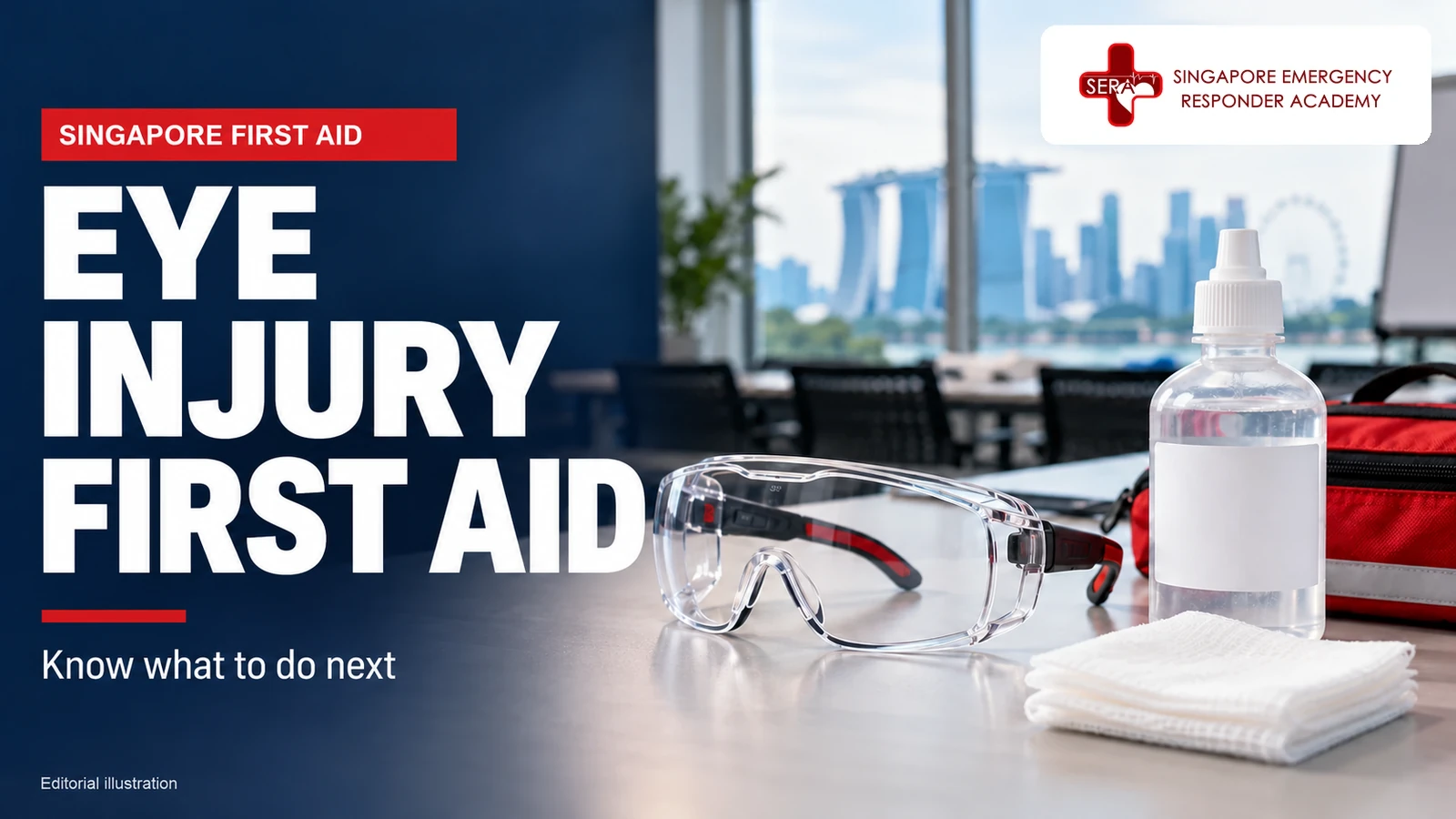
Eye Injury First Aid in Singapore: What to Do Before Getting Help
SERA • Everyday First Aid
Eye Injury First Aid in Singapore: What to Do Before Getting Help
A splash while cleaning, dust during renovation or a fragment from a tool can turn an ordinary task into an eye emergency. Eye injury first aid in Singapore starts with recognising what happened, avoiding further damage and arranging the right medical help.
1. Stop the activity and establish what happened
Move away from the source of danger before helping. Ask whether the incident involved loose dust, a cleaning product, a direct blow or something travelling at speed. Tell the person to avoid rubbing the eye. Wash your hands before assisting whenever possible.
The explanation matters. A gritty eye after windblown dust differs from discomfort after grinding metal. Do not assume that a small visible mark means a minor injury, or repeatedly ask the person to open and close the eye for inspection.
2. Rinse loose surface particles gently
The Singapore National Eye Centre distinguishes superficial particles from objects that penetrate the eye. For a loose surface particle, gentle rinsing with clean water or sterile saline may help. Avoid a forceful jet and stop attempts to physically pick anything out.
Never use tweezers, cotton buds, tissue corners or fingers against the eye surface. If irritation continues after rinsing, obtain medical assessment. Persistent discomfort can mean that a particle remains or the surface has been injured, even when you cannot see anything.
3. Start flushing a chemical splash immediately
If a chemical enters the eye, begin flushing with running tap water immediately. SingHealth’s public eye-condition guidance recommends flushing for 10–20 minutes. Do not spend those first minutes searching for a special eyewash product.
Arrange urgent medical assessment after the splash. Ask another person to identify the product and keep its label or safety information available for the treating team. Do not add another chemical to try to neutralise it. Chemical exposure needs a different response from routine dry-eye irritation.
4. Recognise injuries that need emergency care
Seek immediate help for suspected penetration, especially after hammering or grinding. Do not pull out an embedded object, press on the eye or try to wash the object away. Leave removal to healthcare professionals.
SingHealth also advises emergency assessment for eye pain, sudden loss or disturbance of vision, and discomfort after a chemical splash or injury. Avoid driving yourself if vision is affected. Explain the mechanism clearly when seeking care; “metal fragment during grinding” is more useful than “something in my eye”.
5. Prepare the environment before another incident
SNEC identifies appropriate safety goggles as a way to prevent work-related eye injuries and associated infections. Select protection suited to the task rather than assuming ordinary spectacles provide equivalent coverage.
For a workplace briefing, walk through a simple scenario: who stops the activity, where is clean running water, who accompanies the casualty and who retrieves the product information? At home, keep cleaning products clearly labelled and make sure everyone knows where to rinse an accidental splash.
A useful handover records the affected eye, the activity, the substance or object involved, symptoms and first aid already given. These details support assessment; they do not replace it.
Build practical first aid skills with SERA
Occupational First Aid
Explore workplace first aid training covering eye injuries, other injuries and industrial toxicology.
View Occupational First AidStandard First Aid
Develop broader adult first aid skills, with eye injuries included in the listed syllabus.
View Standard First AidChild First Aid
Parents and caregivers can explore training focused on first aid for children and infants.
View Child First AidPractise before you need to respond
Choose training that fits your workplace, sporting or caregiving role. Check the relevant course page for current arrangements and registration information.
Explore SERA trainingFrequently asked questions
Should I rub my eye to remove dust?
No. Avoid rubbing. Gentle rinsing may help a loose surface particle; persistent irritation needs medical assessment.
Can I use a cotton bud to remove something?
No. SNEC advises against using cotton buds or other solid objects to remove a foreign body.
Should I wait for saline after a chemical splash?
No. Start flushing with running tap water immediately and arrange urgent medical assessment.
What if an object seems embedded?
Do not remove it or press on the eye. Seek immediate medical attention.
Does blurred vision after an injury need attention?
Yes. Vision changes after an eye injury warrant urgent assessment, even if the injury looks small.
Can safety goggles prevent every eye injury?
No equipment removes every risk. Appropriate goggles help reduce exposure, alongside safe work practices and preparation.

Related Posts