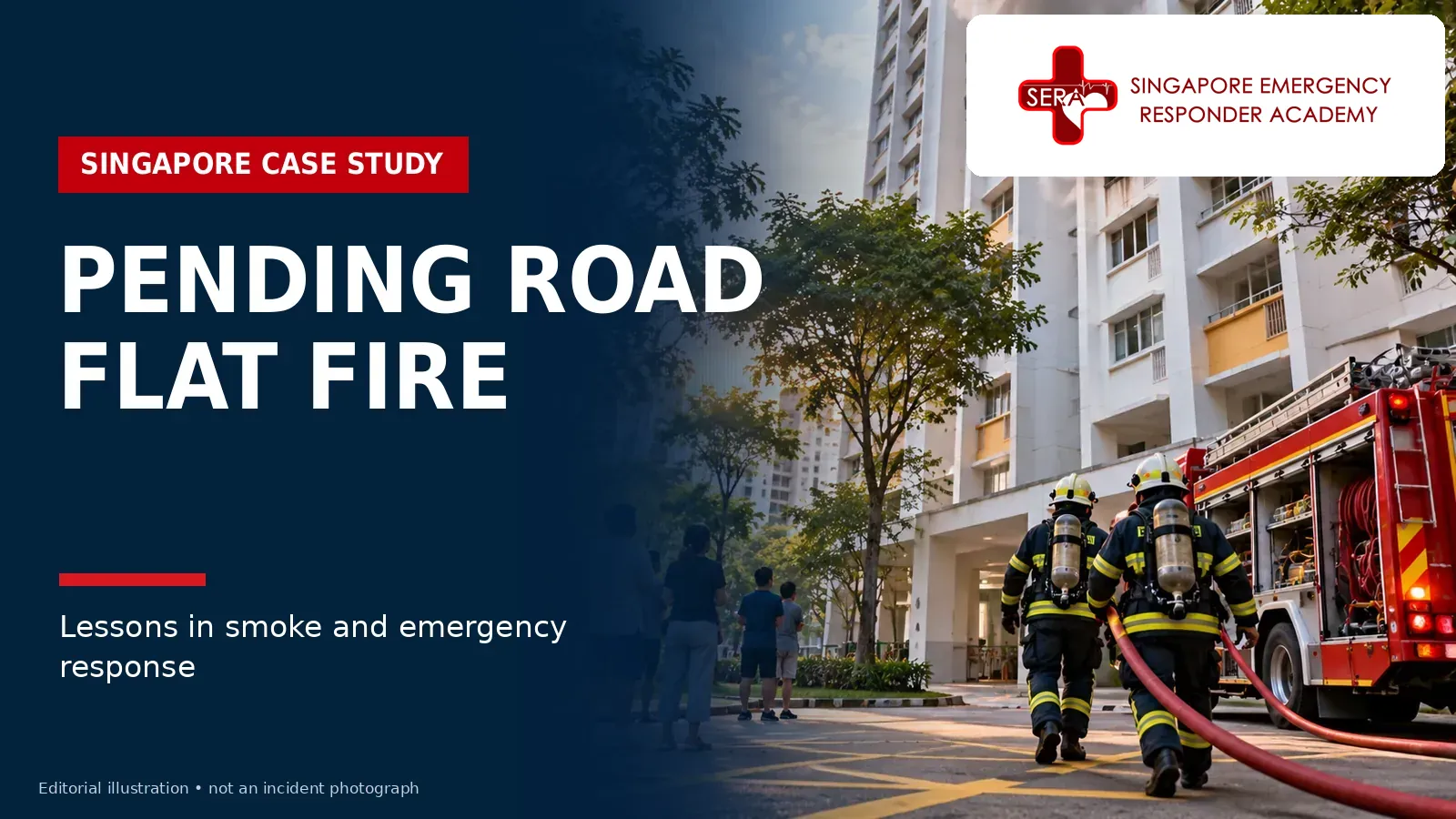
On 28 September 2026, a fire at Block 126 Pending Road in Bukit Panjang prompted the evacuation of approximately 70 residents. SCDF firefighters rescued an unconscious woman and paramedics performed CPR, but she subsequently died. The incident highlights the dangers of smoke exposure and the importance of safe evacuation and emergency preparedness.
SCDF Heavy-Vehicle Rescue: How Responders Freed a Driver Trapped in a Crushed Cabin
Real-Life Emergency Response | Singapore Case Study
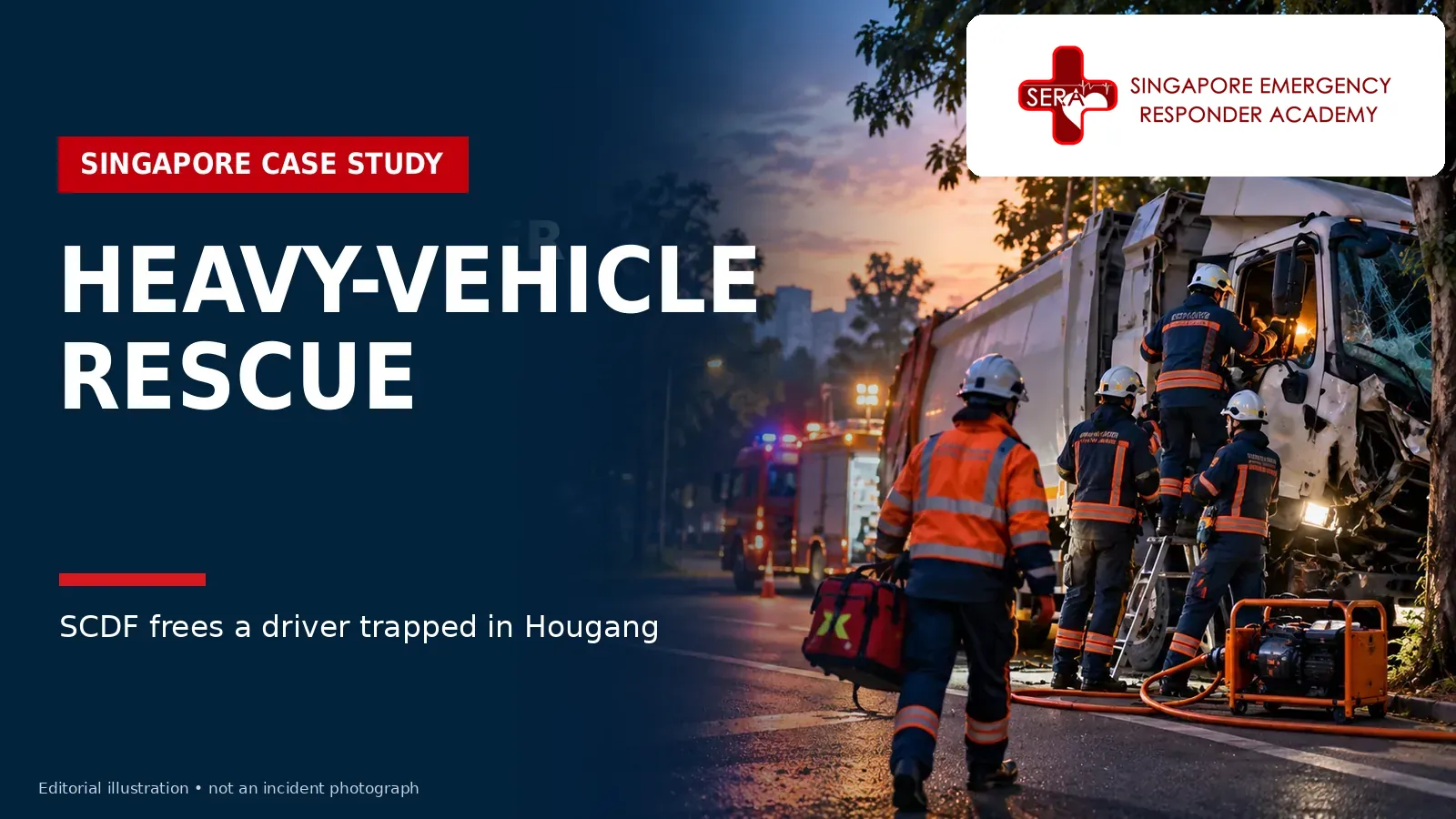
On 24 March 2026, a garbage truck crashed into a tree along Hougang Avenue 3, leaving its driver trapped inside the severely damaged cabin. Singapore Civil Defence Force (SCDF) firefighters, paramedics and Disaster Assistance and Rescue Team (DART) specialists worked together to free the driver and provide medical assistance.
The key takeaway:
Serious road accidents require more
than immediate medical assistance.
Responders must secure the scene,
assess casualties, manage vehicle
hazards and coordinate technical rescue
before injured persons can be
transported safely.
1. What Happened in Hougang?
According to STOMP’s report of the accident , the incident occurred along Hougang Avenue 3 towards Eunos Link, after Lorong Ah Soo. The truck was believed to have self-skidded before crashing into a tree.
SCDF received the emergency call at approximately 5.50am.
Firefighters from Paya Lebar and Changi Fire Stations, together with DART specialists and paramedics, attended the scene.
The driver was trapped in his seat after the front section of the vehicle’s cabin sustained substantial damage.
Two male passengers also sustained minor injuries and were conveyed to hospital.
3 People Conveyed to Hospital
Incident date: 24 March 2026. Location: Hougang Avenue 3, Singapore. The driver was extricated and conveyed to Changi General Hospital. Two passengers were also conveyed to hospital.
2. How Did SCDF Rescue the Trapped Driver?
SCDF subsequently published its account of the rescue operation , explaining the challenges faced by responders.
Unlike a typical passenger car, the heavy vehicle had an elevated cabin. The driver was pinned against the dashboard, making access particularly difficult.
SCDF paramedics and firefighters cross-trained as Emergency Medical Technicians assessed and monitored the casualties.
Meanwhile, DART specialists used hydraulic rescue equipment to remove the damaged door and move the dashboard forward, creating space to free the driver.
Firefighters supported the operation by preparing equipment, improving lighting and keeping the rescue area safe.
Throughout the operation, responders communicated with the trapped driver to monitor his responsiveness and provide reassurance.
Once extricated, the driver was handed over to paramedics for stabilisation and transport to hospital.
What is confirmed:
SCDF documented the use of
hydraulic rescue equipment,
medical assessment and
hospital conveyance.
Contemporary reporting stated
that the driver was unconscious
when conveyed.
No CPR or AED intervention
was reported.
The driver’s subsequent
medical outcome was not established
in the reviewed sources.
3. Five Emergency-Response Lessons
The following recommendations are general first aid and safety lessons. They are not additional claims about actions taken during the Hougang incident.
01
Ensure the Accident Scene Is Safe
Before approaching a crashed vehicle, check for moving traffic, fire, smoke, unstable wreckage and other hazards. Do not place yourself in danger while trying to assist another person.
02
Activate Emergency Services Early
Call 995 for serious injuries or trapped casualties. Provide the exact location, direction of travel, nearest landmark and number of casualties. Explain whether anyone is unresponsive or trapped.
03
Avoid Unnecessary Casualty Movement
Serious collisions may involve head, neck or spinal injuries. Avoid moving injured persons unnecessarily unless there is immediate danger. Follow emergency dispatcher instructions rather than attempting an improvised rescue.
04
Provide First Aid Within Your Competence
If accessible and safe, check responsiveness and normal breathing. Control serious external bleeding using direct pressure where appropriate. If someone is unresponsive and not breathing normally, follow dispatcher instructions for CPR and AED use.
05
Communicate and Reassure
Keep the casualty informed when it is safe to do so. Provide reassurance and observe changes in their condition. Give arriving responders a clear account of the incident and assistance provided.
4. Why Should Bystanders Avoid Technical Rescue?
A damaged vehicle may contain sharp metal, unstable components or other hazards. Cutting doors, manipulating damaged vehicle structures and extricating trapped casualties require specialist training and equipment.
The Hougang operation illustrates why DART specialists and emergency medical personnel work together during complex rescues.
If you encounter a serious road accident:
- Stay clear of moving traffic and unsafe wreckage.
- Call 995 and provide an accurate location.
- Do not attempt to pull trapped casualties from unstable vehicles.
- Offer assistance only when it is safe and within your competence.
- Follow the emergency dispatcher’s instructions.
These recommendations are consistent with SCDF emergency-response guidance.
5. What Can Transport and Logistics Employers Learn?
Organisations operating heavy vehicles should review their accident-response arrangements alongside existing road safety measures.
Drivers and supervisors should know how to report an accident, identify their location and activate emergency assistance.
Workplaces should also maintain appropriate first aid coverage and ensure employees understand the limits of their training.
First aid training prepares employees to provide initial casualty care. It does not qualify them to perform specialist vehicle extrication.
Relevant SERA First Aid Training
Occupational First Aid
Training for appointed workplace first aiders, covering injuries, medical emergencies and CPR+AED.
Explore Occupational First Aid →Standard First Aid
Practical first aid and CPR+AED training for individuals and organisations.
Explore Standard First Aid →CPR + AED
Develop skills to recognise cardiac arrest and provide adult CPR and AED assistance.
Explore CPR + AED →Prepare Your Team for Workplace Emergencies
The Hougang rescue highlights the importance of coordinated emergency response. SERA provides practical first aid and CPR+AED training for Singapore workplaces, including transport and logistics organisations.
Request Corporate TrainingFrequently Asked Questions
1. When did the Hougang heavy-vehicle accident happen?
The accident occurred on 24 March 2026. SCDF was alerted at approximately 5.50am.
2. Where did the accident occur?
The accident was reported along Hougang Avenue 3 towards Eunos Link, after Lorong Ah Soo.
3. How many people were injured?
Three people were conveyed to hospital. The driver was trapped, while two passengers sustained minor injuries.
4. How did SCDF free the driver?
DART specialists used hydraulic rescue equipment to remove the damaged door and move the dashboard forward.
5. Should bystanders pull a trapped driver out?
Do not attempt hazardous vehicle extrication. Call 995 and follow professional instructions.
6. Does Occupational First Aid teach vehicle extrication?
No. Occupational First Aid teaches casualty assessment and initial medical assistance, not specialist rescue techniques.
Official Sources and Further Reading
- SCDF — Racing Against Time for the Rescue
- STOMP — Heavy-Vehicle Accident in Hougang, 24 March 2026
- SCDF — Emergency Medical Services
- SCDF — Emergency Video System
- Singapore Basic Cardiac Life Support and AED Guidelines 2026
This case study discusses an incident that occurred on 24 March 2026. Confirmed rescue actions are distinguished from general first aid recommendations. The featured image is illustrative and does not depict the actual accident or responders.

Related Posts